Building an SEO strategy starts with finding keywords, but organizing those keywords into a strategy requires more than just a spreadsheet. A keyword clustering tool groups semantically related terms and phrases, turning hundreds of scattered queries into clear content opportunities.
If you are a content lead or SEO professional managing a growing website, finding the right tool to cluster keywords means the difference between a messy, cannibalized site structure and a highly organized content calendar. This guide covers how clustering tools work, the different methods they use to group terms, and how to evaluate the free and paid options available to SEO teams right now.
What Is a Keyword Clustering Tool?
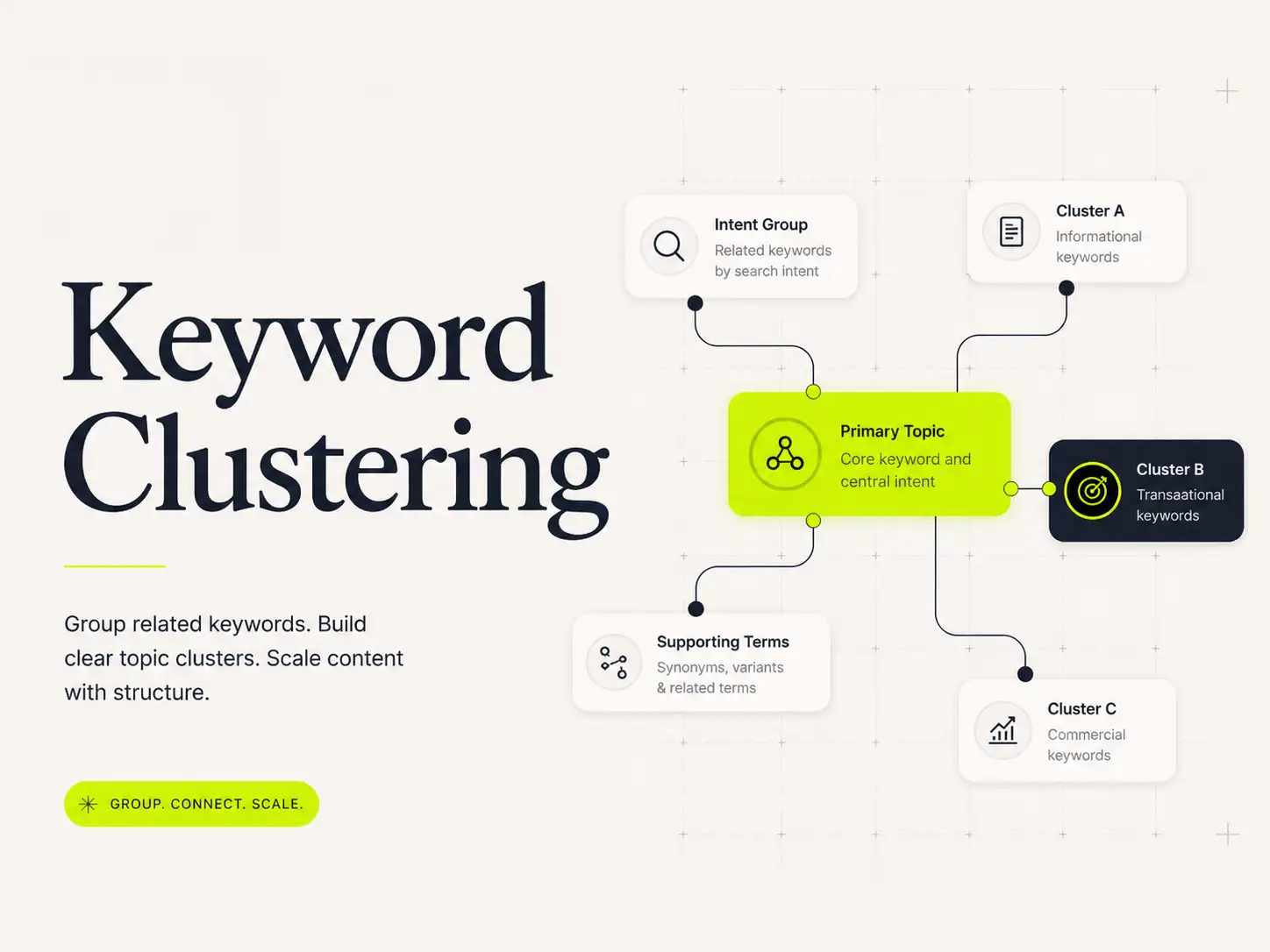
A keyword clustering tool is software designed to automatically group related search terms into topical buckets. Instead of writing one article for “how to write a content brief” and a separate article for “content brief template,” the tool analyzes the relationship between these terms and clusters them together, signaling that they should share a single target page.
Keyword clustering takes raw keyword lists—often pulled from keyword research tools or Google Search Console—and groups them based on shared search intent or language similarities. By clustering these terms, SEO teams can define topic clusters accurately, ensuring that every page targets a primary query alongside its natural variations.
When websites launch, manual grouping in spreadsheets works reasonably well. But as content operations scale to hundreds or thousands of pages, manual clustering becomes impossibly tedious and prone to human error. A dedicated keyword clustering tool automates this process, mapping raw query data directly to publishable content plans.
Why Keyword Clustering Matters for SEO Teams
For content teams and marketers, raw search volume is meaningless without structure. Keyword clustering bridges the gap between raw data and execution.
First, clustering prevents keyword cannibalization before content ever goes live. When teams target highly similar keywords across multiple pages, they force their own pages to compete against each other in the SERPs. Grouping related queries into a single cluster guarantees that content writers understand the full scope of a topic and keeps site architecture clean.
Second, clustering maps directly to your site hierarchy. A strong cluster structure dictates what becomes a broad pillar page, what requires a specific subpage, and what makes sense for programmatic SEO templates. You end up building a map of topical authority rather than chasing isolated, disconnected terms.
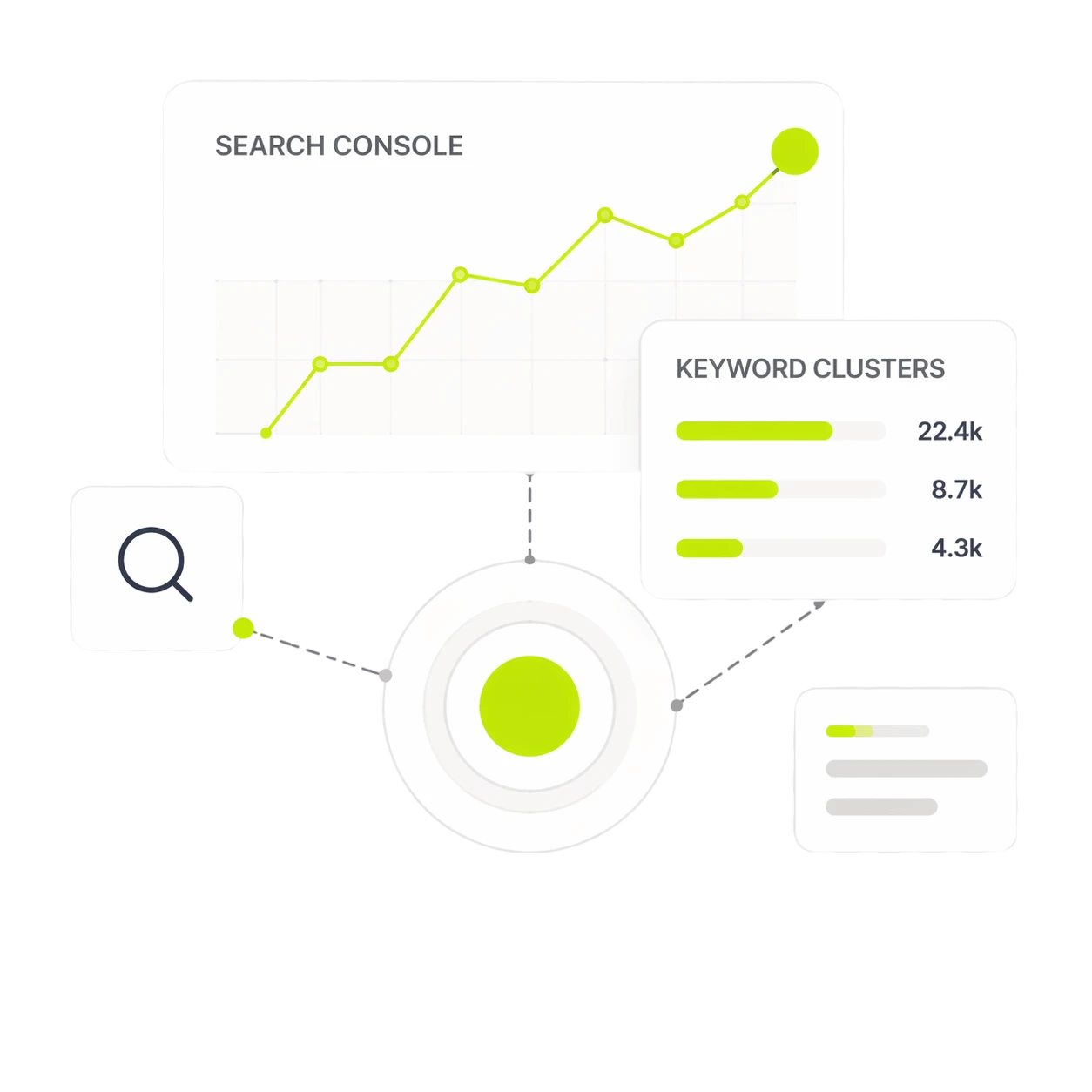
Finally, keyword clustering turns scattered Google Search Console (GSC) queries into actionable SEO tasks. GSC exposes exactly how users find your site, but the raw query report is famously noisy. Clustering your actual GSC data highlights themes where you already have traction, showing you precisely which pages to expand and which gaps to fill.
How Dango Approaches Keyword Clustering with Site-Aware AI
Traditional keyword tools rely entirely on third-party volume estimates and generic SERP data. Dango takes a different approach by focusing on your actual performance data and the context of your specific site.
Dango integrates directly with Google Search Console. Instead of clustering hypothetical search volumes from external databases, Dango pulls your live GSC queries to group the terms your audience is already using. This means you are clustering real performance data, not just theoretical keyword lists.
Beyond just grouping terms, Dango is site-aware. It crawls your existing website to understand your active pages, running themes, and content gaps. When it builds clusters, it knows exactly what you have already published. This site-aware context ensures that new keyword clusters align with your current content rather than duplicating it.
Once the clusters are established, Dango does not leave you with a passive spreadsheet. The platform connects your newly formed clusters directly to content briefs and generates smart internal links based on your actual site structure.
We are building the platform to help teams turn their raw Search Console data into ranked content without the fluff or guesswork. You can request access by joining the waitlist to test this GSC-native workflow.
Best Keyword Clustering Tool Options Compared
Finding the best keyword clustering tool requires matching the tool’s capabilities to your team’s workflow. Here is a look at how the top tools stack up based on methodology, data sources, and intended use cases.
When evaluating your options, consider the following decision matrix:
- Best for GSC Workflows: Dango (pulls live query performance and builds site-aware clusters)
- Best for SERP Overlap Analysis: Keyword Insights, Keyword Cupid (excellent at analyzing live search results to group terms)
- Best for All-in-One Enterprise Suites: Semrush, Ahrefs, SE Ranking (ideal if you want clustering built into your primary rank tracker and research suite)
- Best for Brief Generation Integration: Zenbrief (focuses on turning clustered terms directly into optimization checklists)
Comparing these tools involves looking at accuracy limits, export options, intent labels, and how well they fit into your daily routine. If you need massive programmatic scale, you might prefer a dedicated credit-based API tool. If you want to integrate your clustering directly into content creation with full site context and smart internal linking, a site-aware platform like Dango provides a tighter workflow.
Free Keyword Clustering Tool Options and Their Limits
If you are not ready to commit to a paid subscription, a free keyword clustering tool can help you test the waters. Free tools typically offer basic functionality, allowing you to paste a list of keywords and see how an algorithm groups them based on semantic similarity.
Most free keyword clustering tool options include basic grouping functions and standard CSV exports. However, they usually come with strict limitations. You will often encounter low caps on the number of keywords you can process per day, and the algorithms typically rely on basic natural language processing (NLP) rather than live SERP analysis.
The biggest drawback of free tools is their lack of context. They fall short because they do not understand your existing website. They cannot flag internal linking opportunities, they do not verify against your live Google Search Console data, and they lack accuracy checks for search intent. A free tool might group “apple” the fruit and “Apple” the company simply because the characters match.
If you use a free keyword clustering tool, you must validate the cluster manually. Always check the live search results for your grouped keywords to ensure the search intent matches before assigning that cluster to a writer or building a new page.
SERP-Based vs AI/NLP vs GSC-Native Clustering
Understanding how a tool groups keywords is just as important as the tool itself. The industry uses three primary methodologies.
SERP-Based Clustering
This method groups keywords by analyzing the actual Google search engine results pages. If two different keywords return three or more of the exact same URLs on page one, the tool clusters them together. SERP-based clustering is highly accurate for understanding search intent because it relies on what Google currently ranks. It works well for mapping out entirely new websites or building out completely new topic clusters.
AI/NLP Clustering
AI and natural language processing tools analyze the lexical and semantic similarity between words. They look at the text itself rather than the search results. While faster and cheaper to run, AI/NLP clustering can sometimes miss the mark on search intent. It might group terms that sound similar but serve entirely different user needs.
GSC-Native Clustering
GSC-native clustering groups the real queries that actually drive impressions and clicks to your website. Instead of theoretical research, it clusters your actual performance data around your existing pages. This method is incredibly powerful for established sites looking to run content refreshes, fix keyword cannibalization, or expand upon topics where they already possess topical authority.
Step-by-Step Workflow: From Keywords to Publishable Content Plan
Having a tool is only half the battle; applying a systematic workflow is what actually gets pages ranked. Here is how to move from a raw list to a publishable plan.
Step 1: Export queries from Google Search Console or keyword research tools Start by gathering your raw data. Pull your highest-impression queries from GSC or generate a broad list of target terms from your preferred research tool.
Step 2: Clean duplicates, variants, and irrelevant terms Filter out branded terms that belong to competitors, nonsensical queries, and obvious duplicates. A clean list ensures your clustering tool doesn’t waste processing power on useless data.
Step 3: Cluster by intent, SERP similarity, and page opportunity Run your cleaned list through your keyword clustering tool. Review the output to ensure the clusters align logically.
Step 4: Map each cluster to an existing page, new page, or template This is where site awareness becomes critical. Decide if a cluster justifies a brand new article, if it should be added as an H2 to an existing page, or if it fits into a programmatic SEO template.
Step 5: Generate briefs, internal links, and on-page checks Turn the approved cluster into a content brief. Define the primary keyword, list the secondary terms to include, and map out the internal links required to connect this new page to your broader site architecture.
What to Look for in a Keyword Clustering Tool
Evaluating a keyword clustering tool comes down to evaluating its features against your scale and needs.
First, consider the data source quality. Does the tool rely on your live GSC data, live SERPs, third-party databases, or AI-only inputs? Live SERP and GSC data offer the highest accuracy for actionable SEO.
Next, look at the clustering controls. The best tools allow you to adjust the similarity threshold (how tight or loose the groups should be), filter by language, and segment by search intent.
Workflow outputs are another major factor. A list of grouped keywords is helpful, but tools that automatically generate content briefs, map out page hierarchies, and suggest internal links save massive amounts of administrative time.
Finally, consider scalability. If you are running programmatic SEO campaigns or managing large content libraries, ensure the tool can handle tens of thousands of rows without timing out or crashing your browser.
Example Keyword Cluster Output for a Content Team
To visualize how this works in practice, here is what a mature keyword cluster looks like when prepared for a content team.
| Primary Keyword | Cluster Variants | Search Intent | Target Page Status | Content Type | Internal Links (To/From) |
|---|---|---|---|---|---|
| b2b saas seo | seo for b2b saas, b2b saas seo strategy, saas seo guide | Informational | New Page | Pillar Guide | From: /blog/saas-marketing To: /blog/saas-keyword-research |
| content brief template | how to write a brief, seo brief template | Transactional | Existing (Needs Refresh) | Resource/Download | From: /blog/seo-workflows To: /blog/content-scaling |
Reviewing a table like this makes it easy to spot cannibalization risks. If you see two separate clusters with highly overlapping “Cluster Variants,” you immediately know you need to merge them into one target page. This structured output allows you to turn one cluster directly into a writer’s brief and a publishing checklist.
Recommended Visuals, Templates, and On-Page Assets
When operationalizing your keyword clusters, standardizing your assets keeps your team aligned.
- Comparison tables: Keep a running comparison table for free and paid tools your team uses to track API limits and credit usage.
- Methodology diagrams: Create internal documentation showing the difference between SERP-based, AI/NLP, and GSC-native clustering so your team understands why certain lists are grouped the way they are.
- Cluster-to-brief worksheets: Build a standardized, downloadable spreadsheet template that forces editors to map a primary keyword, cluster variants, and internal links before assigning a draft.
- Workflow mockups: If using a tool like Dango, take screenshots of the cluster-to-brief and internal linking workflow to train new writers and editors on how to execute site-aware SEO.
Frequently Asked Questions
How accurate are keyword clustering tools?
Accuracy depends heavily on the methodology. SERP-based tools and GSC-native tools are highly accurate because they rely on real Google ranking data and live site performance. Tools that rely solely on AI or basic NLP can sometimes misinterpret search intent and group unrelated terms.
Can I use Google Search Console data for keyword clustering?
Yes. Clustering GSC data is one of the most effective ways to optimize an existing website. By grouping your real performance data, you can identify quick-win content refreshes and spot exactly where your current pages are cannibalizing each other.
What is the difference between keyword grouping and keyword clustering?
Keyword grouping is often a manual or basic lexical process (grouping all keywords that contain the word “software”). Keyword clustering uses algorithmic analysis—like semantic relevance or SERP overlap—to group terms based on shared search intent, even if the keywords do not share the exact same words.
How many keywords do I need before using a clustering tool?
If you are working with fewer than 50 keywords, you can likely group them manually. Once your list scales past 100 to 200 terms, a clustering tool becomes essential to save time and prevent overlap errors.
Should every keyword cluster become a new page?
No. A cluster might represent an entirely new page, but it could also represent a new section (like an H2 or FAQ) that needs to be added to an existing article. Always review your current site architecture before publishing a new page.
How do keyword clusters help prevent cannibalization?
Cannibalization happens when multiple pages target the same intent. By grouping all variations of a query into a single cluster before writing, you ensure that only one definitive page is created to answer that specific search intent.
Can AI cluster keywords without SERP data?
Yes, AI can cluster keywords using natural language processing to detect semantic similarity. However, without live SERP data or GSC integration, AI might miss the nuance of actual search intent, leading to less accurate content mapping.
What export format is best for keyword clusters?
CSV or Excel formats are the industry standard as they allow for easy sorting, filtering, and importing into project management tools. Platforms that generate direct content briefs or connect directly to your CMS provide an even faster workflow.
How often should I recluster keywords for an existing site?
It is best practice to re-evaluate your clusters every six to twelve months, or whenever you are planning a major content sprint. Search intent changes over time, and regular GSC-native clustering ensures your existing pages remain aligned with what users are actually searching for.