Finding the right person to execute your organic growth strategy often comes down to hiring a skilled SEO content writer. While many people can string words together, creating content that consistently ranks on Google requires a specific blend of analytical thinking, structural discipline, and editorial judgment.
An effective SEO content writer does not just write. They analyze search intent, interpret Google Search Console (GSC) data, and build assets that drive targeted traffic and conversions. This guide breaks down the core responsibilities, essential skills, and the exact GSC-led workflow that modern SEO content writers use to turn search opportunities into measurable results.
1. What an seo content writer actually does
Writing for search engines and writing for general audiences are two distinct disciplines. An SEO content writer bridges the gap between what users are actively searching for and the solutions your business provides.
How SEO writing differs from general content writing
General content writing often prioritizes narrative, thought leadership, or brand storytelling. It relies on distribution channels like social media or email newsletters to reach an audience. SEO content writing, on the other hand, is reverse-engineered from search demand. Every article, landing page, or guide begins with a proven query. The writer’s primary job is to create the best possible answer to that specific query, matching the format and depth that Google currently rewards.
Why the role is part writer, part researcher, part optimizer
To rank well, an SEO content writer wears multiple hats throughout the creation process. They act as researchers when analyzing the Search Engine Results Pages (SERPs) to understand what competitors are covering. They act as writers when translating complex topics into readable, structured prose. Finally, they act as optimizers when integrating target keywords, structuring headings, and applying internal links based on site architecture.
Common deliverables: blog posts, landing pages, guides, and refreshes
An SEO content writer typically produces a range of specific assets. These include informational blog posts targeting top-of-funnel queries, conversion-focused landing pages for bottom-of-funnel keywords, and in-depth definitive guides. Additionally, a significant portion of their time is spent on content refreshes—updating decaying pages with new data, better structures, or expanded sections to regain lost rankings.
2. SEO content writer vs SEO copywriter: what is the difference?
The terms are often used interchangeably, but an SEO content writer and an SEO copywriter serve different purposes in your marketing funnel. Knowing which one you need depends on your immediate business goals.
When you need educational content vs conversion-focused copy
If your goal is to capture broad search demand, build topical authority, and educate users about a problem, you need an SEO content writer. They excel at structuring long-form informational content that keeps readers engaged while satisfying Google’s algorithms.
If your goal is to drive immediate action—such as form fills, product purchases, or software signups—you need an SEO copywriter. They specialize in persuasive writing, crafting compelling headlines, and optimizing product pages or service pages where the primary intent is transactional.
Where the two roles overlap in search-driven pages
Both roles rely on a foundational understanding of search intent and keyword optimization. Whether writing an educational guide or a high-converting product page, the writer must seamlessly integrate primary and secondary keywords, maintain readability, and structure the page so search engine crawlers can easily understand it. Both professionals also rely on on-page SEO elements like meta descriptions and strategic internal linking.
How to decide which skill set your team needs first
Look at your current website performance. If you have high-converting product pages but no traffic, prioritize an SEO content writer to build top-of-funnel authority. If you have plenty of informational traffic but struggle to convert visitors into customers, an SEO copywriter can help optimize your money pages. Many teams eventually scale to need both, or they use platforms that help hybrid writers execute both strategies effectively.
3. Core skills every strong SEO content writer needs
Evaluating an SEO content writer goes beyond checking for good grammar. A true professional brings a distinct technical skill set to the table.
Search intent analysis and SERP research
Before typing a single word, a skilled writer analyzes the SERP. They identify whether the search intent is informational, navigational, commercial, or transactional. If the SERP is filled with listicles, they know not to write a theoretical essay. They look at the current ranking pages to identify content gaps and structure their piece to deliver a superior user experience.
Keyword usage without over-optimization
Keyword stuffing is a relic of the past. Today’s SEO content writer knows how to naturally weave primary and secondary keywords into introductions, headings, and body copy. They understand semantic search and use related terms that build context without forcing exact-match phrases where they do not belong.
Brief interpretation and content structure
A strong writer knows how to take a structured outline and execute it flawlessly. They use hierarchical headings (H2s, H3s) to break up text, making it scannable for both users and search engines. They follow the required formatting—whether that means bullet points, numbered lists, or comparison tables—to secure featured snippets.
On-page SEO basics: headings, metadata, snippets, and links
Beyond the body copy, writers are responsible for the technical packaging of the content. This includes writing compelling meta titles and descriptions that drive high click-through rates. It also involves optimizing images with alt text and strategically placing internal links to pass authority to other relevant pages on the domain.
Editorial judgment, fact-checking, and brand fit
An SEO content writer must maintain factual accuracy and align with the company’s brand voice. They verify claims, source credible data, and ensure the tone—whether professional, conversational, or highly technical—matches the broader site identity.
4. A practical seo content planning workflow before writing starts
Even the best writer will fail if they are working from a flawed strategy. A robust seo content planning process removes the guesswork and ensures every piece of content has a clear path to ranking.
Start with real query data from Google Search Console
The most effective SEO content writing relies on actual performance data, not just third-party search volume estimates. By analyzing Google Search Console, teams can identify queries where the site is already gaining traction (impressions) but lacking clicks. This raw GSC data forms the foundation of a targeted strategy, highlighting quick wins and exact phrases your audience is already using.
Cluster keywords by topic, intent, and opportunity
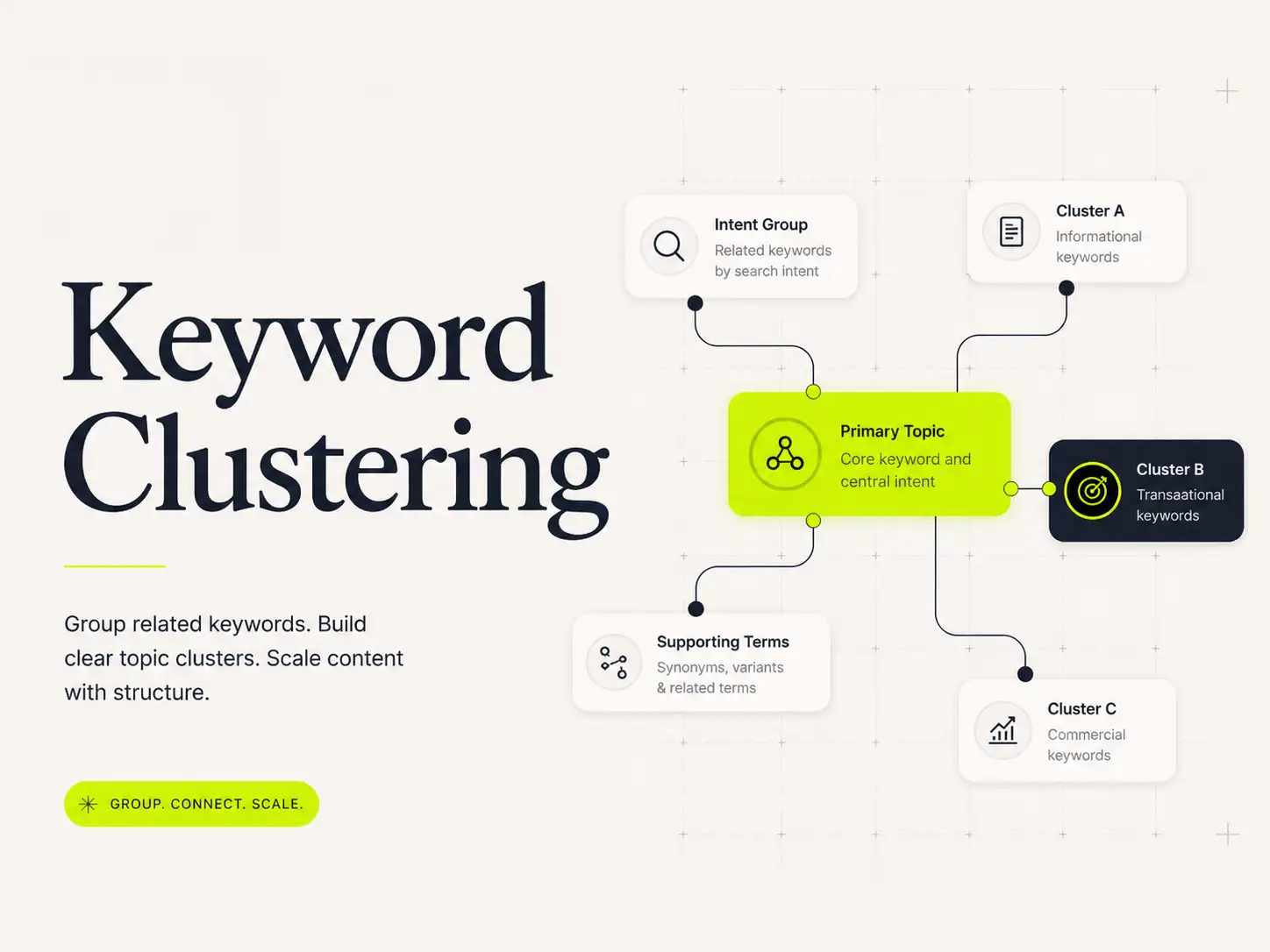
Rather than writing one article per keyword, modern seo content planning involves grouping related terms into keyword clusters. This prevents keyword cannibalization and ensures comprehensive coverage of a topic. By evaluating intent and ranking difficulty for each cluster, teams can prioritize the topics that offer the highest return on investment.
Map each cluster to a new page, refresh, or internal link action
Once clusters are defined, the next step is mapping them to your site architecture. Some clusters require entirely new net-new articles. Others are best served by refreshing an existing, underperforming page. In some cases, the data reveals that you simply need better internal linking to push an existing page higher in the SERPs.
Turn the plan into a writer-ready content brief
A raw keyword list is not enough. The planning phase must culminate in a detailed content brief. This document translates the SEO strategy into a clear set of instructions, ensuring the writer knows exactly what is expected regarding structure, intent, and optimization.
Use AI to speed up research without outsourcing judgment
Tools like Dango allow teams to connect directly to GSC, automate keyword clustering, and generate data-backed briefs instantly. AI excels at analyzing full-site context and structuring outlines, freeing up human writers to focus on execution, nuance, and adding unique value rather than getting bogged down in manual SERP analysis.
5. What to include in an SEO content brief for writers
A well-constructed brief is the difference between a draft that needs endless revisions and one that is ready to publish. Every SEO content brief should contain these critical elements.
Primary keyword, secondary keywords, and search intent
The brief must explicitly state the primary keyword the page is targeting, along with a list of secondary and semantically related keywords. More importantly, it must define the search intent (e.g., commercial comparison, informational guide) so the writer understands the user’s ultimate goal.
Competitor patterns and content gaps
Provide a summary of what the top-ranking competitors are currently doing. What formats are they using? What questions are they failing to answer? Pointing out these content gaps gives the writer a clear angle to make the new piece superior.
Required sections, FAQs, examples, and internal links
Remove structural ambiguity by providing a required outline. Detail the H2 and H3 headings. List the specific frequently asked questions that must be answered at the bottom of the page. Include specific examples the writer should use, and provide the exact internal URLs they need to link to within the body copy.
Audience, angle, tone, and conversion goal
Specify who the content is for. An article written for a junior developer will read very differently than one written for a CTO. Define the brand tone, the unique angle the piece should take, and the specific call-to-action (CTA) or conversion goal the page is designed to drive.
Quality checklist before a draft is submitted
Include a final checklist for the writer. This should cover formatting rules, keyword density limits, heading structures, and proofreading expectations. Setting these standards upfront ensures a smoother editorial process.
6. How to evaluate or hire an SEO content writer
Scaling content production requires finding writers who actually understand search mechanics. When hiring in-house or bringing on freelancers, you need a systematic way to assess their capabilities.
Portfolio signals that show ranking potential
A strong portfolio is not just a collection of nice-sounding articles. Look for live links. Use an SEO tool to check if the articles they wrote actually rank for their target keywords. Pay attention to how they structure their content—are there clear headings, logical flows, and natural keyword integrations?
Questions to ask before hiring a freelance or in-house writer
During an interview, ask tactical questions to gauge their SEO knowledge:
- How do you determine the search intent behind a keyword?
- Walk me through your process for optimizing a page that is stuck on page two of Google.
- How do you balance keyword integration with readability?
- What tools do you use to research competitors?
Red flags: keyword stuffing, thin rewrites, and no SERP analysis
Be wary of writers who mention “keyword density” as their primary metric or who clearly just rewrite the top three ranking articles without adding original insight. If a writer does not mention analyzing the SERP or looking at competitor structures before writing, they are likely not a true SEO content writer.
Simple scorecard for comparing candidates
Create a standard rubric to evaluate test articles or portfolio pieces. Score candidates on:
- Intent match: Did they answer the core query?
- Structure: Are headings used correctly and logically?
- Optimization: Are keywords used naturally?
- Readability: Is the writing clear, engaging, and grammatically correct?
- Internal linking: Did they identify logical places to link to other site content?
7. How AI changes the SEO content writer’s workflow
Artificial intelligence is fundamentally shifting how SEO content is planned and executed. It is not replacing the need for quality, but it is drastically accelerating the process.
Where AI helps: clustering, briefs, outlines, drafts, and QA
AI is incredibly efficient at processing large datasets. It can take thousands of GSC queries, group them into logical clusters based on intent, and generate comprehensive outlines in seconds. AI can also assist in drafting initial sections, suggesting internal links based on site crawls, and running quality assurance checks against target keywords.
Where human writers still matter: expertise, examples, nuance, and accuracy
While AI handles structure and scale, human writers inject the actual value. AI cannot share a personal anecdote, conduct an original interview, or perfectly capture the nuanced tone of a specific brand. Human writers are essential for fact-checking, refining arguments, and ensuring the content reads naturally and persuasively.
How dango.sh’s GSC-native approach supports faster content production
Dango connects directly to your Google Search Console to eliminate manual spreadsheet work. By pulling real performance data, clustering keywords automatically, and generating detailed SEO briefs with built-in internal linking recommendations, Dango gives writers a battle-ready plan. This full-site context ensures writers spend their time crafting high-quality prose rather than guessing what to write about next.
8. How to measure whether SEO content writing is working
Content production is only half the battle. You must actively track performance to validate your strategy and justify your investment in SEO writing.
Rankings, impressions, clicks, CTR, and average position
The most immediate indicators of success live in Google Search Console. Track impressions to see if your content is being served for target queries. Monitor clicks and Click-Through Rate (CTR) to evaluate the effectiveness of your title tags and meta descriptions. Watch your average position to track momentum as the page climbs the SERPs.
Engagement and conversion metrics beyond traffic
Traffic is useless if it does not drive business value. Use your analytics platform to monitor time on page, bounce rate, and scroll depth to ensure the content actually engages users. More importantly, track conversion events—newsletter signups, demo requests, or purchases—to measure the direct ROI of the content.
When to refresh, consolidate, or internally link a page
Content requires ongoing maintenance. If a page stalls on the second page of Google, it may just need stronger internal links from high-authority pages on your domain. If a once-popular post starts losing traffic, it is time for a refresh. If you have multiple articles competing for the exact same intent, consolidate them into one authoritative guide.
How to build a repeatable content improvement loop
Treat SEO content as an iterative process. Publish the best possible version of a page, wait for Google to index and rank it, and then analyze the GSC data a few months later. Identify the specific queries the page is naturally picking up, update the content to better target those terms, and repeat the cycle.
9. SEO content writer checklist for teams
Standardizing your workflow ensures consistency across your entire content operation. Use this checklist to keep every asset on track.
Before writing: data, intent, and brief checklist
- GSC data analyzed for keyword opportunities
- Keywords clustered by search intent and difficulty
- Competitor SERP analysis completed
- Content brief generated with required headings and FAQs
- Brand voice and conversion goals clearly defined
During writing: structure, examples, and optimization checklist
- Primary keyword used naturally in the H1 and introduction
- H2 and H3 headings used for logical hierarchy
- Search intent satisfied within the first few paragraphs
- Concrete examples and unique brand insights included
- Semantically related secondary keywords integrated smoothly
After publishing: indexing, internal links, and performance checklist
- Compelling meta title and description added
- Relevant internal links placed within the body copy
- Page submitted for indexing via Search Console
- Calendar reminder set to review performance data in 90 days
Frequently Asked Questions
How much should you pay an SEO content writer?
Rates vary widely based on experience, niche expertise, and location. Freelance SEO content writers typically charge between $0.10 and $0.50 per word, or $200 to $800+ per article for highly technical or specialized B2B content. In-house salaries generally range from $50,000 to $90,000 annually, depending on the market and the writer’s ability to handle strategy alongside execution.
Can an AI tool replace an SEO content writer?
No, but it heavily augments their workflow. AI is excellent at automating research, clustering keywords, and generating outlines. However, human writers are still required to ensure factual accuracy, inject brand voice, provide real-world examples, and apply the nuanced editorial judgment that Google’s quality raters look for.
What should an SEO content writer include in a portfolio?
A strong portfolio should include live links to published articles, evidence of the keywords those articles rank for, and case studies showing traffic or conversion growth. It should demonstrate an ability to write across different formats (e.g., long-form guides, landing pages) while adhering to strict SEO structures.
How long does it take SEO content writing to produce results?
SEO is a long-term strategy. For a brand new website, it can take 6 to 12 months to see significant organic traction. For established domains with existing authority, a well-optimized piece of content can begin ranking on the first page and driving traffic within 4 to 8 weeks.
Does an SEO content writer need access to Google Search Console?
While junior writers executing strict briefs may not need direct access, senior SEO content writers absolutely do. GSC provides the exact query data needed to understand how users find a site, what keywords represent low-hanging fruit, and how a page should be optimized after publishing.
Should SEO content writers also do keyword research?
In many lean teams, yes. A complete SEO content writer is capable of handling the entire lifecycle, from keyword research and clustering to drafting and optimization. In larger organizations, an SEO manager might handle the initial research and pass detailed briefs to the writers.
How many articles can one SEO content writer produce per month?
This depends on the depth and complexity of the content. A full-time writer producing heavily researched, 2,000-word authoritative guides might write 8 to 12 pieces a month. A writer handling shorter, less technical posts or utilizing AI workflows for research and outlining might produce 15 to 20 high-quality pieces in the same timeframe.
What mistakes make SEO content fail to rank?
Common reasons SEO content fails include misidentifying search intent (e.g., writing a guide when users want a tool), keyword stuffing that hurts readability, lacking internal links to pass authority, and producing thin content that simply repeats what competitors have already said without adding unique value.