Most keyword clustering advice stops at the grouping step. You feed a list into a tool, it spits out tidy buckets, and then you’re left staring at a spreadsheet wondering which bucket becomes a page, which one merges into something you already published, and which one is a trap that will cannibalize an existing ranking.
This guide skips the abstract theory and works through real keyword clustering examples that end in decisions: a target page, a brief angle, an internal link plan, and a place on your content roadmap. Every example leans on data you can actually verify—Google Search Console queries, SERP overlap, and your own site structure—so the output reflects what Google already knows about your site rather than a third-party estimate of what might work.
What a Keyword Cluster Looks Like in Practice
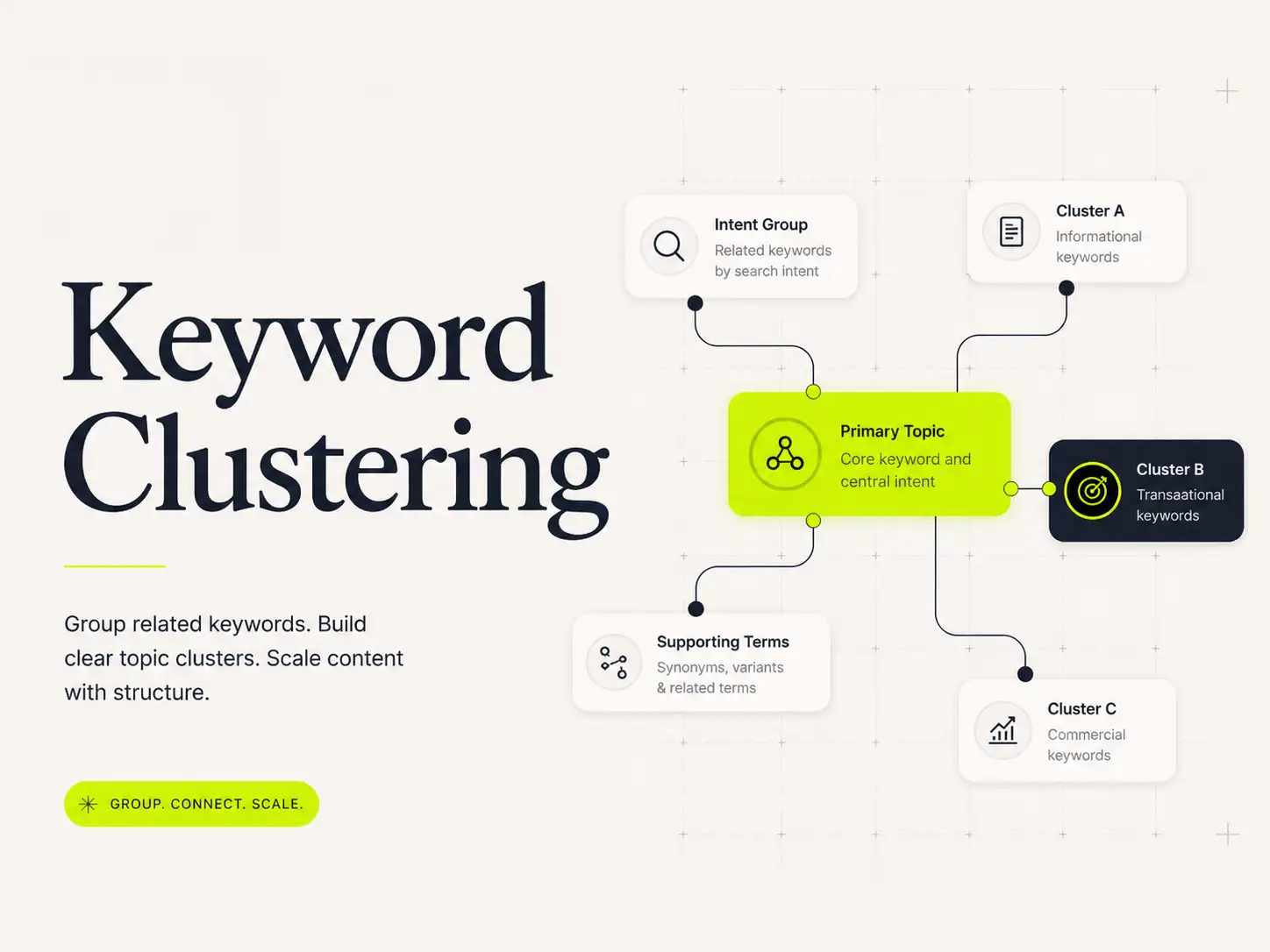
A keyword cluster is a group of search queries that should be served by a single page because they share the same underlying intent. That’s the definition that matters. Everything else—volume, modifiers, synonyms—is supporting detail. The test for whether two queries belong together isn’t whether they sound similar; it’s whether a searcher typing either one would be satisfied by the same answer.
The core parts of a useful keyword cluster
A cluster you can act on contains more than a list of words. The version that turns into a brief usually has six parts, mirroring the structure Dango uses in its own cluster output:
| Field | What it captures |
|---|---|
| Primary keyword | The head term the page targets and titles around |
| Cluster variants | Secondary queries the page should also satisfy |
| Search intent | Informational, commercial, transactional, navigational |
| Target page status | New page, existing page, or existing-needs-refresh |
| Content type | Pillar guide, blog post, comparison, resource, template |
| Internal links | Which pages link in, which pages this links out to |
A bare list of fifteen related keywords isn’t a cluster you can hand to a writer. Those six fields are what convert a grouping into a publishing decision.
How primary keywords, secondary keywords, and intent fit together
The primary keyword anchors the page. It’s the term you write the title and H1 around, and usually the one with the clearest commercial or topical importance to your business. Secondary keywords are the variants, synonyms, and related questions the same page can answer without splitting focus—they shape your H2s, your subsections, and the natural language inside the body.
Intent is the glue. Two keywords can look like obvious siblings and still belong on different pages because one is a buyer comparing options and the other is a beginner trying to understand a concept. “Best project management software” and “what is project management software” are semantically close, but the first wants a ranked list and the second wants a definition. Same topic, different jobs, different pages.
When one cluster should become one page versus multiple pages
The split decision comes down to a single question: can one page genuinely satisfy every query in the group without becoming two articles stapled together? If the answer is yes, keep it as one page. If you find yourself planning a section that could stand alone as its own ranked result, that’s a signal you have two clusters wearing one label.
This is where topic clusters and keyword clusters part ways. A topic cluster is a strategic content structure—a pillar plus supporting pages around a theme. A keyword cluster is the query-level grouping that decides what each of those pages actually targets. You build topic clusters out of keyword clusters, not the other way around.
Example 1: Turning Google Search Console Queries into a Blog Post Cluster
Generic keyword tools tell you what people might search. Search Console tells you what people are already searching to find your site. For any domain with baseline traffic, that’s the higher-signal starting point.
Start with real impressions instead of generic keyword ideas
Imagine you export your last three months of GSC data and filter for queries with high impressions but low click-through—the page is showing up, but not winning the click. You spot a band of related queries already attached to one existing URL:
| Query | Impressions | Clicks | Position |
|---|---|---|---|
| email open rate benchmarks | 4,210 | 38 | 11.4 |
| average email open rate | 3,890 | 51 | 9.7 |
| good email open rate 2026 | 1,640 | 12 | 14.2 |
| email open rate by industry | 2,310 | 9 | 18.6 |
| what is a good email open rate | 1,980 | 22 | 12.1 |
These aren’t ideas. They’re queries Google is already testing your site against, and the positions tell you you’re close but not converting impressions into clicks.
Group queries by shared intent and existing ranking URL
Every query in that table answers the same question from a slightly different angle: how do my email open rates compare? The intent is informational and consistent. They also map to the same ranking URL, which confirms Google already treats them as one topic served by one page.
The outlier worth watching is “email open rate by industry,” sitting at position 18.6. It’s part of the same intent, but the gap in position hints the current page doesn’t cover the industry breakdown well. That’s not a reason to split—it’s a reason to strengthen one section.
Decide the target page, brief angle, and internal link opportunities
The cluster resolves into a clear decision:
- Primary keyword: average email open rate
- Variants: email open rate benchmarks, good email open rate 2026, email open rate by industry, what is a good email open rate
- Intent: Informational
- Target page status: Existing — needs refresh
- Content type: Benchmark blog post
- Brief angle: Lead with the headline benchmark, then break down by industry (closing the position-18 gap), then explain what counts as “good” and how to improve it
- Internal links: Link in from your email marketing pillar; link out to your guide on improving open rates
This entire chain—from raw impressions to a refresh brief—is the heart of a GSC-first SEO framework. You’re not guessing what to write; you’re responding to demand Google has already surfaced.
Example 2: Using SERP Similarity to Decide Whether Keywords Belong Together
Intent grouping handles most decisions, but borderline cases need a tiebreaker. The most reliable one is the SERP itself. If Google ranks the same pages for two queries, Google is telling you they’re the same job.
Compare overlapping ranking pages in the top results
The working rule: if two keywords share three or more of the exact same URLs on page one, they belong in the same cluster. Take two candidates:
| Query | Top page-one URLs (sample) |
|---|---|
| how to start a podcast | A, B, C, D, E |
| podcast equipment for beginners | A, B, F, G, H |
Only two URLs overlap (A, B). That’s below the threshold. Google is serving mostly different pages, which means the two queries want different things—one wants a process, the other wants a gear list.
Spot when two similar keywords need separate URLs
Now compare a second pair:
| Query | Top page-one URLs (sample) |
|---|---|
| how to start a podcast | A, B, C, D, E |
| starting a podcast guide | A, B, C, D, F |
Four shared URLs. These are the same cluster—merging them onto one page is correct, and trying to rank a separate page for “starting a podcast guide” would just split your authority across two near-identical assets.
Use SERP differences to avoid accidental cannibalization
SERP overlap is also your early warning system against keyword cannibalization. Before you greenlight a new page, check whether its target SERP is already dominated by one of your existing URLs. If your own page already ranks for the new query—and the SERP for that query overlaps heavily with a page you’ve published—you don’t need a new page. You need to expand the one you have. Two pages chasing one SERP rarely both win; usually they trade positions and neither breaks through.
Example 3: Building a Semantic Cluster for Long-Tail Variants
Long-tail clustering is where teams most often overbuild, creating dozens of thin pages for queries that are really just phrasings of one need.
Group modifiers, synonyms, and related questions
Start by collapsing the obvious variations of one core query. For “standing desk”:
- Modifiers: electric standing desk, adjustable standing desk, small standing desk
- Synonyms: sit-stand desk, height-adjustable desk
- Questions: are standing desks worth it, how high should a standing desk be
At first glance this looks like one big bucket. But semantic similarity alone won’t tell you how many pages you need.
Separate semantic similarity from true search intent
Run the intent filter and the bucket fractures cleanly:
| Query group | Intent | Page |
|---|---|---|
| electric / adjustable / small standing desk | Commercial — wants to compare products | Buying guide |
| sit-stand desk, height-adjustable desk | Commercial — same as above | Merge into buying guide |
| are standing desks worth it | Informational — wants evidence | Blog post |
| how high should a standing desk be | Informational — wants a how-to | Blog post (or section) |
Semantically, all six belong together. By intent, they split into a commercial page and one or two informational pages. The semantic relationship tells you they’re a topic cluster; the intent tells you the page boundaries inside it.
Map long-tail queries into headings without keyword stuffing
Once a long-tail variant lands inside a page rather than getting its own URL, it becomes a heading or a paragraph, not a forced repetition of the exact phrase. “How high should a standing desk be” becomes an H2 phrased naturally as a question, with the answer written for a human. The query informs the structure; it doesn’t dictate awkward exact-match wording sprinkled through the copy.
Example 4: Creating a Pillar Page and Supporting Cluster
Individual clusters are useful, but they get powerful when you stack them into a pillar-and-supporting structure that signals topical authority.
Choose the broad topic for the pillar page
The pillar targets the broadest commercially relevant term you can plausibly compete for. Using the example structure Dango illustrates, a B2B software company might choose “b2b saas seo” as a pillar—a high-intent head term with enough breadth to support a long, definitive guide and enough sub-questions to justify a network of pages beneath it.
The pillar’s job is coverage and links, not depth on every subtopic. It introduces the whole landscape and routes readers (and link equity) to the pages that go deep.
Assign subtopics to supporting pages
Each meaningful subtopic becomes its own keyword cluster and its own supporting page:
| Supporting page cluster | Primary keyword | Intent |
|---|---|---|
| Keyword research for SaaS | saas keyword research | Informational |
| SaaS content strategy | b2b saas content marketing | Informational |
| SaaS link building | saas link building | Informational |
| SaaS SEO agencies | saas seo agency | Commercial |
Notice the last row carries a different intent. It still belongs in the topic cluster, but the page that serves it looks nothing like the others—it’s a comparison or service page, not a how-to.
Plan internal links before writing the content
The link plan is decided at the cluster stage, not after publishing. The pillar links down to every supporting page; every supporting page links back up to the pillar; and closely related supporting pages cross-link where it genuinely helps the reader. Mapping this before a single draft exists prevents the orphan-page problem and ensures internal linking reinforces the hierarchy you intended rather than whatever you remember to add later.
Example 5: Clustering Keywords for a Programmatic SEO Page Set
Programmatic SEO flips the unit of work. Instead of one cluster per page, you cluster modifiers that fill a repeatable template across hundreds of pages.
Group modifiers by page template, audience, and use case
Say you run a payroll product and want a page for every “[software] integration” query. Your modifiers are the integration partners, and they group by the template that serves them:
| Template | Modifier group | Example pages |
|---|---|---|
| [Product] payroll integration | accounting tools | QuickBooks, Xero, FreshBooks |
| [Product] payroll integration | HR platforms | BambooHR, Gusto, Rippling |
| [Product] for [industry] | industry use cases | restaurants, agencies, clinics |
Each row uses one template; each value inside fills the variable. The cluster isn’t a set of queries for one page—it’s a set of values for one page type. Operationalizing this well usually means assembling a proper programmatic SEO tool stack so the clustering, data enrichment, and publishing stages connect instead of living in disconnected spreadsheets.
Identify thin-page risks before scaling content
The danger with programmatic sets is scale without substance. Before you generate 300 pages, check whether each modifier has enough unique data to justify a standalone page. A “QuickBooks integration” page with real setup steps, screenshots, and a feature comparison earns its existence. A page that’s identical to 200 others with only the product name swapped is a thin-page liability that invites a quality penalty.
The clustering stage is where you catch this. If a modifier group can’t produce meaningfully different pages, consolidate those values onto a single comparison page instead of templating them out. SaaS teams scaling this kind of page set should study the specific patterns in programmatic SEO for SaaS, which covers template design, data models, and the human-review rules that keep large sets from going thin.
Prioritize clusters by business relevance, not just volume
Volume is the wrong sole criterion for ordering a programmatic roadmap. The “QuickBooks integration” page might have lower search volume than a generic “payroll software” query, but it targets users who are mid-evaluation and ready to convert. Sequence your page sets by commercial relevance and conversion intent first, then use volume as a tiebreaker among similarly valuable clusters.
A Step-by-Step Keyword Clustering Workflow You Can Reuse
Here’s the repeatable process the examples above all follow, distilled into five stages.
Collect queries from GSC, keyword tools, sales calls, and SERPs
Start with Search Console, because those queries carry confirmed intent toward your domain. Supplement with keyword tools for terms you don’t yet rank for, sales and support call transcripts for the phrasing real prospects use, and “people also ask” boxes from the SERPs you care about. The combination gives you both proven demand and net-new opportunity.
Clean and normalize the keyword list
Strip duplicates, collapse near-identical variants, remove branded queries you can’t act on, and filter out terms that are clearly irrelevant to your business. A clean list of 400 meaningful queries clusters far better than a raw dump of 4,000 noisy ones.
Cluster by intent, SERP overlap, and site authority
Group first by intent, then validate borderline cases with the three-shared-URL SERP test, then sort by where you have a realistic chance of ranking given your existing authority. Site authority matters here: a cluster you can win in three months should usually outrank a higher-volume cluster you’d need two years to compete for.
Convert each cluster into a brief, page type, and publishing priority
This final stage is where clustering pays off. Each cluster becomes a content brief with a defined primary keyword, secondary keywords, intent, page type, internal link plan, and a slot on the roadmap. Deciding who owns each of these steps—clustering, briefing, drafting, linking—keeps the workflow from stalling; if you’re formalizing roles, mapping out keyword clustering and content brief tools by responsibility helps an SEO team run this on repeat rather than reinventing it every quarter.
Manual, AI, and Tool-Based Clustering: Which Method Fits Each Example?
No single method wins every time. Match the method to the size and stakes of the job.
When manual clustering is enough
For a small list—say under 100 queries for a focused content push—manual clustering in a spreadsheet is fast, accurate, and gives you full control. You understand your business better than any algorithm, and at small scale that judgment beats automation. Example 1’s blog-post cluster and Example 4’s pillar planning are perfectly manageable by hand.
When SERP-based tools are worth using
Once you’re validating overlap across hundreds of queries, manually checking page-one results becomes impractical. SERP-based tools automate the URL-overlap comparison from Example 2 at scale, grouping keywords by shared ranking pages in minutes. They’re strongest for net-new topics where you have no GSC history to lean on, though their accuracy depends on SERP stability. If you’re weighing specific platforms, this deeper keyword clustering tool comparison breaks down SERP-based, AI/NLP, and GSC-native methods side by side.
When GSC-native and site-aware AI creates better page decisions
For established sites, the highest-leverage method clusters your real Search Console queries against your actual site structure. This is where AI that understands your existing pages earns its place: it can cluster live queries, flag when a new cluster would cannibalize a published URL, and propose internal links grounded in pages you actually have. That site-aware layer is the difference between a generic grouping and a grouping that knows what you’ve already published—exactly the kind of decision support behind the programmatic and refresh examples above.
Common Mistakes These Keyword Clustering Examples Help You Avoid
Creating one page per keyword instead of one page per intent
The classic error is treating every keyword variant as a page. “Average email open rate,” “good email open rate,” and “what is a good email open rate” don’t need three pages—they need one strong page, as Example 1 showed. One page per intent is the rule; one page per keyword fragments your authority and creates internal competition.
Mixing informational and commercial queries in the same cluster
Example 3 showed why this fails. Bundling “are standing desks worth it” with “buy electric standing desk” produces a page that does neither job well—too salesy for the researcher, too thin for the buyer. Split on intent even when the keywords look semantically identical.
Ignoring existing ranking URLs and internal links
Clustering in isolation from your current site produces plans that collide with what you’ve already published. Before committing a cluster to a new page, check whether an existing URL already ranks for those queries. If it does, refresh it—don’t compete with yourself. Plan internal links at the cluster stage, not as an afterthought.
Over-relying on keyword volume while missing ranking opportunities
The biggest roadmap mistake is sorting purely by search volume. A cluster sitting at position 11 with 4,000 monthly impressions—like the one in Example 1—is often a faster, more valuable win than a higher-volume term where you don’t rank at all. Prioritize by the combination of business relevance and proximity to page one, and let volume break ties rather than make decisions.
Frequently Asked Questions
How many keywords should be in one keyword cluster?
There’s no fixed number—a cluster can hold three queries or thirty. What matters is whether one page can satisfy all of them with a single intent. If a cluster grows so large that you’re planning sections that could each rank as standalone pages, it’s a sign to split it into two clusters.
Can one keyword belong to more than one cluster?
Occasionally, yes. An ambiguous query that serves two intents—or a broad modifier that fits multiple page templates in a programmatic set—can legitimately appear in more than one cluster. But it should be rare. If many keywords are landing in multiple clusters, your intent boundaries are too fuzzy and you’re at risk of building cannibalizing pages.
What is the difference between keyword clustering and keyword mapping?
Clustering groups queries by shared intent. Mapping assigns each cluster to a specific URL—new, existing, or refresh. Clustering tells you what belongs together; mapping tells you where it lives on your site. The cluster output table in this guide blends both: the variants are the cluster, the target page status is the mapping.
Do low-volume keywords still matter in a keyword cluster?
Yes. Low-volume queries often carry high intent and high conversion value—integration and comparison queries are a prime example. Inside a cluster, low-volume variants also strengthen topical coverage and help the page rank for the head term. Don’t discard a query just because the volume estimate is small, especially when GSC shows it’s already driving impressions.
How do you validate a keyword cluster before writing content?
Run three checks. First, the SERP test: do the keywords share three or more page-one URLs? Second, the intent test: would one page satisfy every query? Third, the cannibalization test: does an existing page of yours already rank for this cluster? If a cluster passes all three, it’s safe to brief and write.
Should ecommerce, SaaS, and local SEO sites cluster keywords differently?
The principles are identical, but the page outcomes differ. Ecommerce clusters often resolve to category and product pages with commercial intent. SaaS clusters frequently produce feature pages, comparisons, and programmatic integration sets. Local SEO clusters split heavily by location modifier, where the same service across cities becomes a templated page set. Cluster by intent first; the page type that intent points to varies by business model.
How often should keyword clusters be updated?
Treat clusters as living, not fixed. Re-pull GSC data quarterly to catch new queries your pages are starting to rank for and to spot emerging clusters. Revisit immediately after a major content push or a Google update, since both can shift which queries your URLs surface for. Established sites benefit most from a regular refresh-and-prune cadence rather than one-time clustering.
Can AI cluster keywords accurately without Google Search Console data?
AI can cluster a raw keyword list by semantic and SERP similarity without GSC—and for net-new topics, that’s often all you have. But the clusters it produces are generic; they don’t know which pages you’ve already published or which queries are currently driving impressions to your site. Grounding AI clustering in Search Console data is what turns a plausible grouping into a real page decision, because it lets the model account for your actual rankings, cannibalization risk, and internal link structure rather than working in a vacuum.