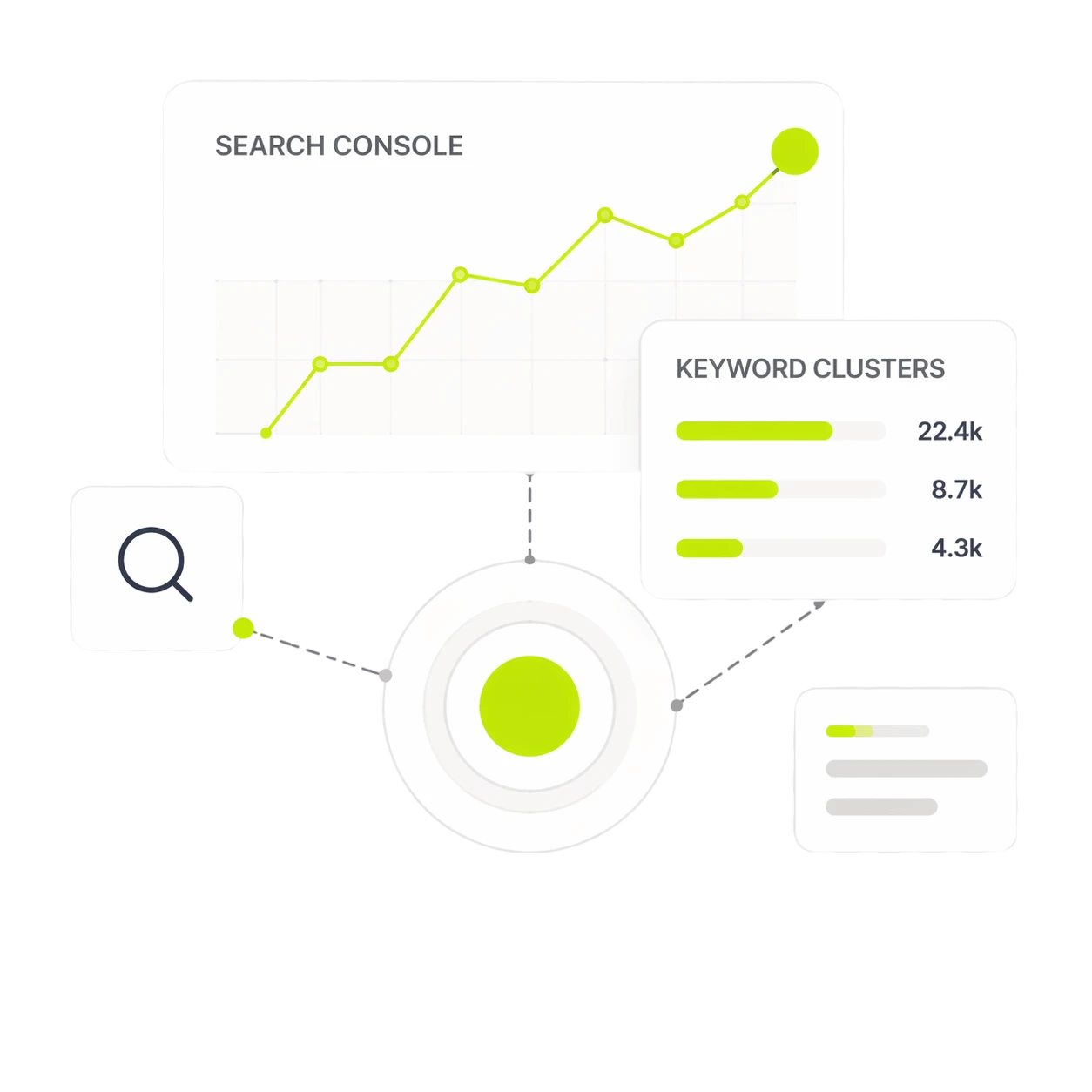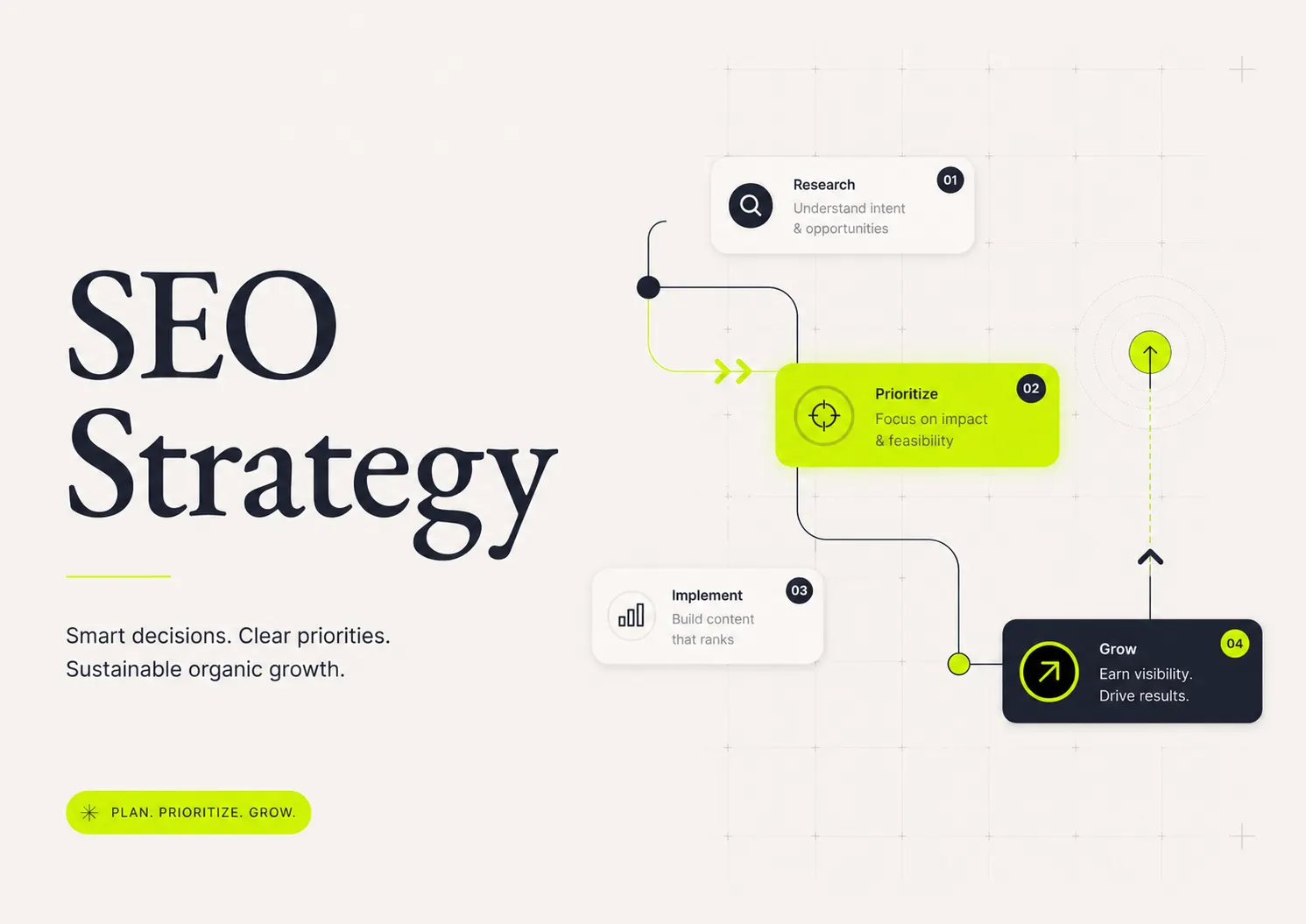
Every SEO team eventually hits the same wall. The data is there — impressions climbing, queries accumulating in Search Console, pages hovering on page two — but nothing is moving because no one owns the decision. Not because the team is lazy or underresourced, but because the operational model never caught up with the ambition.
Building an SEO team is not a hiring problem. It is a systems problem. The org chart is the easy part. What separates SEO teams that compound results from teams that spin are clear role ownership, a single source of truth (Google Search Console), and workflows that turn data into published content without losing two weeks in meetings.
This guide covers what each role actually does, how to size and structure a team by company stage, which KPIs matter and which create noise, and how to build a GSC-first operating rhythm that works whether you have one person or ten.
What Is an SEO Team and When Do You Need One?
An SEO team is the group of people — in any combination of in-house, outsourced, or AI-assisted — responsible for growing a site’s organic search presence. That includes finding opportunities, creating content, fixing technical problems, building authority, and measuring the results.
The harder question is not what one is, but when you need one.
Signs SEO Has Outgrown One Person
A single person can run early-stage SEO effectively. They can track rankings, publish a handful of posts per month, fix obvious technical issues, and do enough to see traction. But organic search has a compounding structure that eventually breaks the solo model.
Watch for these signals:
- There are more keyword clusters identified than content being produced — the backlog is growing faster than publishing
- Technical issues are being discovered weeks or months after they appear
- Content is published without a strategy for internal linking or topic clusters
- No one owns GSC review consistently, so opportunities are missed until they become emergencies
- The team is measuring traffic but not understanding why it moves
Any one of these suggests SEO has become a function, not a task, and needs dedicated ownership.
In-House Team vs. Agency vs. Freelancer vs. AI-Assisted Workflow
None of these options are universally correct. The real question is where your bottleneck sits.
In-house team gives you institutional knowledge, alignment with product roadmap, and consistent brand voice. The cost is headcount, onboarding time, and the risk of a team that optimizes for internal processes rather than external results.
Agency gives you speed, specialization, and capacity without permanent headcount. The risk is shallow understanding of your product, rotating account teams, and incentive structures that reward deliverables over outcomes.
Freelancers work well for specific skill gaps — a technical SEO audit, content writing at volume, a link building campaign. They require clear briefs and someone internal to manage quality.
AI-assisted workflows are now a real option for leaner teams. Tools like Dango connect directly to Google Search Console and automate the path from raw query data to content brief to published article, which can compress what used to require an analyst, a strategist, and a writer into a single workflow step. AI does not replace judgment, but it removes a significant amount of the mechanical work that used to consume team capacity.
Most companies at growth stage run a hybrid: an internal SEO lead or manager who owns strategy and priorities, supported by a mix of freelancers, agencies, and AI tooling for execution.
Why Most SEO Teams Fail: Too Much Data, Too Few Decisions
The most common SEO team failure mode is not a skills gap. It is an operational gap. Teams spend enormous amounts of time in tools — crawlers, rank trackers, third-party keyword platforms, analytics suites — and produce dashboards full of data and very few decisions.
GSC alone generates enough signal to build a full content roadmap. The problem is that most teams treat it as a reporting tool rather than an operational input. Pages with 2,000 impressions and a 1.2% CTR sitting at position 14 are actionable. They do not need a third-party tool to confirm the opportunity. They need someone to make a decision and execute.
SEO teams that perform well have fewer tools, faster decision cycles, and a direct line from GSC data to published content.
The Core Roles Every SEO Team Needs
A mature SEO function has six distinct responsibilities. In small teams, one person may cover several. In larger teams, each becomes a dedicated role. The failure mode is not understaffing — it is unclear ownership, where nobody knows who holds the brief on a given problem.
SEO Lead or SEO Manager: Strategy, Prioritization, and Accountability
The SEO manager is the most important hire in any team structure. This role owns the strategy: which topic clusters to pursue, how to prioritize the content roadmap against business goals, how to allocate budget between content production and technical work, and how to report results to leadership.
A strong SEO manager does not spend their time doing deep keyword research or editing individual posts. They spend it setting priorities and removing blockers. They are the person who decides that this quarter’s focus is commercial intent pages, not top-of-funnel traffic, because the business needs pipeline, not impressions.
Without a clear SEO manager, every other role operates in a vacuum.
Technical SEO Specialist: Crawlability, Indexation, Performance, and Site Architecture
Technical SEO is the infrastructure layer. Crawlability, indexation, Core Web Vitals, site architecture, canonical tags, structured data, redirect chains — none of these are glamorous, but all of them directly affect whether Google can find, understand, and rank your content.
In smaller teams, this responsibility often falls to the SEO manager or a developer. At growth stage, it becomes its own role. Technical issues tend to accumulate quietly and compound fast. A page that was accidentally noindexed six months ago is a real ranking loss, and most teams only find it during a quarterly audit.
The technical SEO specialist should own a regular crawl schedule, GSC index coverage monitoring, and a triage process for technical issues that comes before content requests in the development queue.
Content Strategist: Keyword Clusters, Briefs, and Editorial Roadmap
The content strategist bridges data and execution. They take the opportunity signals from GSC and other sources and translate them into a structured content roadmap: which pages to build, which to update, how to cluster topics across the site, and what each piece needs to accomplish to rank.
In practice, this role is often folded into the SEO manager function at smaller companies. But the work itself — cluster mapping, brief creation, competitive SERP analysis, editorial calendar management — is significant enough that it often becomes its own role as the publishing cadence scales beyond six to eight pieces per month.
SEO Content Writer or Editor: Search Intent, Structure, and Quality
The SEO content writer is not a copywriter who has learned a few SEO tricks. This is a distinct function that combines search intent analysis, content structure design, on-page optimization, and editorial quality. A strong SEO writer reads a brief and knows not just what to say but how to organize it to match what Google is surfacing in the SERP.
The SEO content writer role sits at the intersection of reader experience and search signal. They need to understand heading structure, internal linking logic, what entities belong in the content, and how to match the tone and depth that the query actually demands — not just what the brand wants to say.
At scale, this role often splits into writer (production) and editor (quality and brief adherence), which is a useful separation once publishing velocity crosses around fifteen pieces per month.
SEO Analyst: GSC Reporting, Forecasting, and Opportunity Analysis
The analyst is responsible for turning data into decisions. In practice, that means owning the GSC review cadence, building the reporting framework the team uses, identifying ranking movements (up and down), forecasting the impact of content investments, and surfacing opportunities the rest of the team has not acted on yet.
This is not a purely technical role and not a purely strategic one. The analyst needs enough technical fluency to pull the right data and enough strategic context to know what matters. A good analyst is the early warning system for the team — they catch rank decay before it becomes a traffic drop, and they find the high-impression, low-click pages that the SEO manager should be prioritizing next quarter.
Developer, Designer, and Product Partners: Execution Beyond Marketing
SEO does not live entirely inside the marketing team. Technical fixes require developer time. New landing pages require design input. Product teams control the pages that often have the highest business value — feature pages, comparison pages, integrations — and they frequently make changes that affect SEO without realizing it.
Effective SEO teams build formal relationships with their developer, design, and product counterparts. That means an SLA for technical SEO tickets, regular cross-functional reviews where product roadmap changes are flagged for SEO impact, and a shared vocabulary so developers understand why a redirect chain or a JavaScript rendering issue is worth their sprint time.
How to Structure an SEO Team by Company Stage
Headcount and structure should follow the complexity of the problem, not the ambition of the roadmap. Over-hiring before processes exist is as damaging as under-hiring during a growth phase.
Solo or Founder-Led SEO: The Minimum Viable Setup
At the earliest stage, one person — often the founder, a content lead, or a generalist marketer — runs SEO. The goal here is not comprehensiveness. It is finding the two or three highest-leverage moves: setting up GSC properly, identifying the topic clusters most likely to drive qualified traffic, and publishing consistently enough to start building topical authority.
The minimum viable setup is GSC connected, a basic keyword cluster list, a publishing cadence of two to four posts per month, and a simple tracking sheet. Nothing more needs to exist yet.
Small SaaS Marketing Team: One SEO Lead Plus Writing Support
The next stage is typically an SEO lead (or a marketing manager who owns SEO) supported by one or two writers — either in-house or freelance. At this point, the strategy function and the execution function are still partially merged in the SEO lead role, but there is enough separation to start building process.
This is also the stage where programmatic SEO team roles become relevant. For SaaS companies with product data that maps to search queries — integration pages, use case pages, comparison pages — a small team can punch well above its weight with a template-and-data approach, as long as someone owns the SEO logic and someone (or something) handles the technical publishing infrastructure.
Growth-Stage Team: Specialist Roles and Shared Workflows
At growth stage, the generalist model breaks. The SEO lead can no longer also do the GSC analysis, write briefs, manage writers, run technical audits, and report to the VP of Marketing without something falling through the cracks. This is where specialist roles begin to make sense.
A typical growth-stage SEO team might look like:
- One SEO manager who owns strategy and prioritization
- One technical SEO specialist (could be 50% shared with a broader web team)
- One content strategist who owns the brief and cluster process
- Two to four content writers (mix of in-house and freelance)
- One analyst (could be shared with the broader marketing analytics function)
Workflows become critical at this stage. The team needs a repeatable process for moving from GSC data to published content to measurement — something every team member can execute without waiting for the manager to make every call.
Enterprise or Multi-Brand Team: Pods, Governance, and Reporting Layers
Enterprise SEO teams face different problems than small teams. The challenge is not finding opportunities — it is coordination, governance, and consistent execution across multiple sites, brands, or business units.
At this scale, teams often organize into pods: cross-functional groups aligned around a specific site, product line, or market. Each pod has its own SEO lead and content function, but shares infrastructure (tooling, reporting, technical standards) with a central SEO function that owns governance and cross-site strategy.
Reporting layers multiply at this stage, and the temptation is to solve coordination problems with more meetings rather than better processes. The teams that perform best at enterprise scale have standardized briefs, shared KPI frameworks, and documented decision rights — so individual pod leads can execute without escalating every question.
Agency Model: Repeatable Processes Across Multiple Client Sites
Agencies face the same coordination challenge as enterprise teams, but without the institutional knowledge advantage. The solution is the same: standardized processes, clear role definitions within each client team, and tooling that compresses the overhead of running GSC analysis, brief creation, and reporting across multiple sites simultaneously.
The key differentiator for high-performing SEO agencies is the quality of their templated workflow. A brief template that works across ten clients saves more time than any single tool. A tiered QA process that catches brand voice issues before they reach the client matters more than a faster writer.
Where Should the SEO Team Sit in the Organization?
Reporting structure has more operational impact than most teams realize. Where SEO sits determines which problems get prioritized, who it collaborates with naturally, and what success looks like internally.
SEO Inside Content Marketing
The most common placement. SEO inside content marketing works well when content production is the primary SEO lever and when content and SEO strategy are genuinely aligned. It works less well when commercial page optimization, technical SEO, or developer collaboration are equally important — because those functions naturally create friction with a content-first reporting line.
SEO Inside Demand Generation
Demand gen alignment makes SEO more accountable to pipeline and revenue than to traffic. This is good for commercial focus but can create pressure to deprioritize top-of-funnel content that compounds over time. If the demand gen lead thinks of SEO as another paid channel, they will evaluate it on the same time horizon — which almost always disadvantages organic.
SEO as a Standalone Growth Function
Some companies, particularly B2B SaaS organizations where organic is a primary acquisition channel, give SEO its own reporting line directly to the VP of Growth or CMO. This creates more autonomy and clearer accountability. The risk is isolation — an SEO team without natural connective tissue to content, product, and development creates friction at every handoff.
SEO Inside Product or Web Teams
Product alignment makes sense when the site is the product — for marketplaces, directories, or SaaS tools where the majority of high-value pages are product-generated rather than editorial. Technical SEO and CRO are naturally adjacent to web team priorities. The challenge is that content SEO often gets deprioritized in a product context.
Decision Matrix: Choose Placement by Bottleneck, Not Politics
The right reporting structure is whichever one removes the current bottleneck. If developer time is the constraint, SEO close to the web team makes sense. If content production is the constraint, SEO inside content marketing removes friction. If the primary problem is strategic alignment with revenue, a standalone growth function creates the right incentives.
Do not choose a reporting structure because it is how the last company was organized. Map the current bottlenecks, identify which reporting line minimizes coordination overhead for those specific problems, and build in a formal review point (annually, or after any significant organizational change) to reassess.
SEO Team KPIs: What to Measure Beyond Traffic
Traffic is the KPI that gets reported in every dashboard and explains almost nothing about whether an SEO team is operating well. A traffic increase can come from a single viral post that never repeats. A traffic decrease can mask a shift in query patterns that actually represents a strategic improvement.
Effective SEO measurement has three layers.
Leading Indicators
These are the signals that predict future performance before it shows up in traffic or revenue:
- Impressions: The total number of times your pages appear in Google results. Growing impressions without proportional click growth usually signals a CTR or title/meta problem.
- Average position: Movement in average position for target keyword clusters indicates whether content improvements are working. A page moving from position 18 to position 11 is a meaningful signal even before clicks change.
- CTR: Click-through rate is a content and metadata problem. Low CTR at positions 4–10 is often more actionable than average position work.
- Index coverage: How many pages are being indexed, and how many are excluded and why. Drops in index coverage often precede traffic drops by four to eight weeks.
- Content velocity: How many briefs are being created, content pieces published, and pages updated per sprint. This is a team operational metric, not a Google metric.
Lagging Indicators
These are the outcomes that matter to the business but that SEO can only influence, not control:
- Organic conversions: Form fills, trial signups, demo requests attributed to organic traffic
- Pipeline sourced from organic: For B2B SaaS, this is typically the most credible SEO metric for executive reporting
- Assisted revenue: Organic touchpoints that appear in the conversion path even when another channel gets the last-click credit
- Retention signal: Organic search as an engagement channel for existing customers finding help documentation, feature content, and use case articles
Operational KPIs
These measure whether the team is actually executing — and they are the most predictive of future organic performance:
- Briefs created per month
- Pages published per month
- Pages refreshed per quarter
- Internal links added per publishing cycle
- Technical issues triaged per sprint
A team that publishes ten well-structured, well-linked pieces per month consistently will outperform a team that publishes twenty pieces with no internal linking strategy and no refresh cadence, every time.
How to Use Google Search Console as the Team’s Source of Truth
GSC is not one input among many. For a GSC-first SEO team, it is the operating system. Every content decision, every refresh prioritization, every technical audit starts with a GSC data pull.
The most actionable view is the high-impression, low-CTR filter: queries where your pages are being shown but not clicked. This is your clearest signal of either a relevance gap (the page does not match what the user wants at that position) or a presentation gap (the title and meta description are not compelling enough to earn the click). Both are fixable. Neither requires a third-party tool to find.
Position 8–30 is the most valuable range to monitor — these are pages close enough to page one that targeted improvement has a realistic path to ranking uplift within a quarter.
How Big Should Your SEO Team Be? Sizing and Budget Guidance
Team size should be a function of site complexity, publishing cadence, and the role organic search plays in the acquisition model — not a benchmark from a different company in a different market.
Team Size by Site Size, Publishing Cadence, and Technical Complexity
A rough framework:
| Site Context | Publishing Cadence | Recommended Team Size |
|---|---|---|
| Early-stage, under 100 pages | 2–4 posts/month | 1 generalist + AI tooling |
| Small SaaS, 100–500 pages | 4–8 posts/month | 1 SEO lead + 1–2 writers |
| Growth SaaS, 500–2,000 pages | 8–15 posts/month | 3–5 specialists |
| Enterprise, 2,000+ pages | 15+ posts/month | 6–12 across pods |
Technical complexity adds headcount independently of publishing volume. A site with complex JavaScript rendering, frequent product-driven page changes, or multiple language variants needs dedicated technical SEO capacity regardless of how much content it is producing.
What to Hire First When Budget Is Limited
The sequence matters. If you have budget for one hire, it should be the SEO manager or SEO lead — not a writer. Strategy without execution is frustrating, but execution without strategy produces content that does not compound into anything.
The second hire should be writing capacity: an in-house SEO writer or a strong freelance relationship. The third hire depends on the bottleneck: if technical issues are piling up, a technical SEO specialist. If content volume is the constraint and quality is solid, more writing capacity.
When to Outsource Writing, Technical Audits, or Link Building
Writing is the most commonly and successfully outsourced SEO function. The key is having internal brief quality that is strong enough to produce consistent output without heavy editing. If your briefs are thin, you will spend more time editing than you saved outsourcing.
Technical audits outsource well as a periodic engagement — a quarterly or semi-annual deep audit from a specialized agency or freelancer, combined with internal ownership of ongoing monitoring. Understanding how to evaluate an SEO writing service applies equally to technical SEO vendors: look for a clear process, transparent deliverable definition, and evidence of results in comparable site contexts.
Link building is the function most teams outsource and most agencies underdeliver on. Digital PR tends to work best in-house when there is genuine editorial or product news to pitch. Outreach-based link building at scale typically requires a specialist, whether internal or external.
Budget Categories
A practical budget framework for a growth-stage SEO team:
- People: 60–70% of total SEO budget (in-house salaries plus any outsourced writing or specialist work)
- Tools: 10–15% (GSC is free; the platform layer for clustering, brief generation, and reporting is where costs compound)
- Content production: 10–20% (freelance writing, design for content assets, video if applicable)
- Development: 5–10% (technical SEO work, page speed improvements, template builds)
- Measurement and reporting: 5% (dashboarding, data infrastructure beyond basic analytics)
The GSC-First SEO Team Workflow
A workflow is only useful if it reduces decision overhead rather than adding to it. The GSC-first workflow is designed around first-party data, and every step moves the team closer to a published, optimized, internally linked page.
Step 1: Find High-Impression, Low-Click Opportunities
Open GSC. Filter for pages or queries with more than 500 impressions and a CTR below 3% in the last 90 days. This is your highest-priority working list. These are pages Google is already showing for relevant queries — the problem is conversion from impression to click, or the pages are ranking too low to earn meaningful clicks.
Sort by impressions descending and position range 8–30. That intersection — visible in Google results but not yet on page one — represents your most actionable short-term opportunities.
Step 2: Cluster Keywords into Topics and Pages
Raw queries from GSC need grouping before they become actionable. Group queries by shared search intent and semantic relationship, not just keyword similarity. A cluster might include ten variants of the same question — all of which should be addressed by a single, comprehensive page rather than ten separate pieces.
Dango automates this clustering step directly from your GSC data, grouping queries by topic and mapping them to existing pages or flagging gaps that need new content. For teams doing this manually, the principle is: one page per intent cluster, not one page per keyword.
Step 3: Prioritize by Ranking Upside and Business Value
Not all clusters are equally worth pursuing. Prioritization should weight two dimensions: ranking upside (how close is the page to page one, and what would moving there require?) and business value (what does the query signal about where the user is in the buying journey?).
A query cluster around a competitor comparison page ranks higher in priority than a broad informational cluster, even if the informational cluster has more impressions, because the conversion value per click is orders of magnitude higher.
Step 4: Create Briefs Before Assigning Content
A brief is not optional. A brief is the mechanism by which strategy translates into execution. Without a brief, writers optimize for what they know rather than what the SERP demands. A brief should include: the primary keyword and cluster, the target URL (existing or new), the search intent, the required sections or subheadings, internal links to include, and the competitor pages that are currently ranking.
This step is where most SEO teams lose time. Brief creation does not need to take two hours per page. With a GSC-first workflow and a consistent brief template, it should take fifteen to thirty minutes.
Step 5: Publish With Internal Links Already Planned
Internal links are not an afterthought. They should be identified in the brief and confirmed before publishing. Every new piece of content should link to two to five existing pages that share topical relevance. Every existing page it will strengthen should have a link added pointing to the new piece.
Publishing without internal links is the single most common and most damaging execution mistake in SEO content operations. It isolates new content from the site’s existing authority structure and slows indexation.
Step 6: Refresh, Consolidate, or Redirect Underperforming Pages
Pages that existed before the current workflow need to be treated as assets to optimize, not legacy content to ignore. A quarterly GSC review should identify:
- Pages with declining impressions (refresh or consolidate)
- Pages competing for the same cluster (consolidate into a single stronger page)
- Pages with no impressions after six months (redirect or noindex)
The refresh cycle is often where the highest ROI SEO work happens. Updating an existing page that already has some authority is almost always faster than building a new page from scratch to the same performance level.
Tools an SEO Team Actually Needs
The average SEO team runs too many tools. Each tool generates data. Enough data without clear ownership creates paralysis rather than productivity. A lean, effective tool stack covers six functional needs.
Google Search Console and Analytics Tools
GSC is mandatory and free. It is the only source of first-party search performance data. Pair it with GA4 for on-site behavior data. These two tools cover the majority of what most SEO teams need for reporting and opportunity identification.
Crawling and Technical SEO Tools
Screaming Frog (or a cloud-based equivalent like Sitebulb) for regular site crawls. A log file analyzer if the site is large enough that crawl budget management is relevant. GSC’s index coverage report handles surface-level technical monitoring; a crawler handles the deeper structural issues.
Keyword Clustering and Content Brief Tools
This is where the investment in specialized tooling pays off most clearly. Manual clustering is time-consuming and inconsistent. Automated clustering tools, particularly those that pull directly from GSC data rather than third-party volume estimates, compress the strategy cycle significantly.
AI SEO Tools for Research, Briefs, and Workflow Acceleration
AI SEO tools vary enormously in quality. The useful ones are specific about what they automate and where human review is required. Review the best AI SEO tools for your team with a clear framework: does this tool reduce decision overhead, or does it produce more outputs that still require a human to evaluate?
Dango sits in this category as a platform that connects GSC to clustering to brief generation to content production in a single workflow — specifically designed to compress the path from raw search data to ranked content for lean in-house and agency teams.
Project Management and Documentation Tools
Linear, Notion, Asana, or whatever the broader team already uses. The specific tool matters less than the practice: every SEO task should exist in a shared system with clear ownership, status, and due date. A content brief that lives in a Google Doc with no associated task is a brief that will not get executed.
How AI Changes the SEO Team Without Replacing It
AI has materially changed what a small SEO team can accomplish. It has not changed what SEO teams need to accomplish — ranking for queries that matter, building topical authority, maintaining technical health, and converting organic traffic into business outcomes. The difference is in the ratio of hours required per output.
Tasks AI Can Safely Speed Up
- GSC data analysis and cluster identification
- First-draft content brief generation from SERP analysis
- Meta title and description variants for A/B testing
- Internal link recommendations based on semantic similarity
- Technical issue triage and categorization from crawl data
- Content refresh prioritization based on rank decay signals
- Reporting summaries and stakeholder-ready dashboards
These are tasks where the work is mechanical, pattern-based, or involves processing more data than a human can efficiently review. AI handles volume; humans validate output.
Tasks That Still Require Human Strategy and Judgment
- Search intent interpretation for ambiguous or novel queries
- Brand voice and positioning decisions
- Deciding which clusters align with business priorities this quarter
- Evaluating whether a piece of content actually serves the reader
- Managing relationships with developers, product teams, and executives
- Making judgment calls on YMYL topics where AI output carries real risk
- Identifying when Google’s ranking behavior for a topic has fundamentally shifted
The teams that lose performance to AI-assisted workflows are the ones that remove human judgment from the tasks where it is irreplaceable, not the ones that use AI to eliminate mechanical work.
Quality Control Checkpoints for AI-Assisted SEO Work
Every AI-assisted workflow needs defined checkpoints. For content:
- Brief review before assigning to AI or writer
- Intent match check — does the draft answer what the query actually asks?
- Internal link audit — are the planned links present and accurate?
- Brand voice and accuracy review before publishing
- Post-publish GSC check at 30 and 90 days to measure performance against projection
Without checkpoints, AI-assisted content production scales problems as fast as it scales output.
How Dango Fits Into a Lean SEO Team Workflow
Dango is designed specifically for the workflow gap that kills most lean SEO teams: the space between GSC data and published content. It connects to GSC, clusters queries into actionable topics, generates content briefs using actual site content and search data, and handles the internal linking recommendations that are the most consistently missed step in manual workflows.
For a team of one to five people, Dango eliminates the analyst and strategist work that would otherwise require a full-time hire. For agencies, it provides the repeatable process infrastructure that makes running ten client sites with a lean team operationally viable. Explore AI agent workflows for SEO teams for a deeper look at how to build multi-step automation around the same GSC-first framework.
Common SEO Team Mistakes to Avoid
Hiring Writers Before Building a Strategy
Writing capacity without strategic direction produces content volume without topical cohesion. A team that hires two writers before the SEO manager has built a keyword cluster strategy will spend those writers’ first three months producing content that does not compound. Writers should be the second hire, not the first.
Measuring Only Organic Traffic
Traffic is not a business outcome. A team that optimizes for traffic will chase high-volume keywords that attract visitors who never convert, while underprioritizing the commercial intent pages that actually drive pipeline. Add organic conversions and sourced pipeline to every SEO report, even if the attribution is imperfect.
Publishing Without Internal Links
This deserves its own call-out because it is so common. Every page published without a planned internal link structure starts its life isolated from the site’s topical authority. Even one or two strong internal links — from existing pages with relevant content to the new page — can meaningfully accelerate indexation and ranking progress.
Separating Technical SEO From Content Planning
Technical SEO and content SEO are not separate programs. A content plan that ignores crawl budget, page speed, or canonical structure will waste publishing investment on pages that Google cannot properly evaluate. A technical SEO roadmap that does not account for content architecture misses the most impactful structural improvements. These functions should meet at least monthly.
Letting Tools Create More Decisions Instead of Fewer
Every tool you add to an SEO stack should reduce the number of decisions the team needs to make, not increase them. If a new tool produces reports that require another meeting to interpret, it is adding overhead. Evaluate tools on decision compression: does using this tool help me act faster and with more confidence, or does it produce data that creates more questions?
SEO Team Templates and Checklists
SEO Team Role Scorecard
Use this to evaluate whether each role on the team has clear ownership and is operating effectively.
| Role | Primary Accountability | Weekly Output | Key Metric |
|---|---|---|---|
| SEO Manager | Strategy and roadmap | Sprint priorities, stakeholder updates | Pipeline attributed to organic |
| Technical SEO | Site health and indexation | Issues triaged, fixes shipped | Index coverage, CWV scores |
| Content Strategist | Cluster roadmap and briefs | Briefs created, editorial calendar updated | Brief velocity |
| SEO Writer | Published, on-brief content | Pages published, pages edited | Content quality score, CTR |
| SEO Analyst | GSC reporting and opportunity ID | Weekly GSC review, opportunity list | Impressions change, position movement |
Weekly SEO Operating Rhythm
Monday: GSC review — check for position changes, CTR drops, and new high-impression queries from the prior week. Update the priority queue.
Tuesday–Wednesday: Brief creation for the current sprint’s content. Assign to writers with deadline.
Thursday: Technical review — check index coverage, any new crawl errors, Core Web Vitals flags. Triage with developer if needed.
Friday: Content review and publication. Internal link additions to existing pages for any new content published.
Monthly: Full cluster review — which clusters are gaining, which are stalling. Refresh prioritization list. Budget vs. output review.
Quarterly: Technical audit, content consolidation review, KPI reporting to leadership.
Content Brief Checklist
Before every piece of content is assigned, confirm:
- Primary keyword and cluster identified from GSC data
- Target URL defined (new or existing page)
- Search intent documented (informational, commercial, navigational, transactional)
- Top 3–5 ranking competitor pages reviewed
- Required H2 structure outlined
- Internal links planned (minimum 2–3 existing pages to link to and from)
- Word count range based on SERP benchmark, not arbitrary targets
- Unique angle or differentiator noted
- CTA and conversion goal defined
SEO Team KPI Dashboard Outline
A practical SEO dashboard should have four views:
Performance view: Organic clicks, impressions, average position, and CTR — trended by week and month, segmented by cluster or page type.
Opportunity view: High-impression, low-CTR pages. Position 8–30 pages by cluster. New query clusters emerging in the last 30 days.
Operational view: Briefs created, content published, pages refreshed, internal links added — per sprint and month.
Business view: Organic conversions, sourced pipeline, assisted revenue — attributed to organic with appropriate caveats.
Hiring and Outsourcing Evaluation Checklist
Before making any hiring or outsourcing decision:
- Is this a recurring need or a one-time project? (Recurring → in-house or retainer; one-time → project freelancer)
- What is the brief quality required? (Low brief quality → in-house writer; high brief quality → outsource viable)
- What is the institutional knowledge dependency? (High dependency → in-house; low dependency → outsource viable)
- Is the bottleneck speed, quality, or cost? (Speed → AI tooling or agency; quality → senior specialist hire; cost → junior hire or AI-assisted)
- What is the lead time to productive output? (Factor into decision: a strong freelancer is often productive in two weeks; an in-house hire in three months)
Frequently Asked Questions
What is the first SEO role a small company should hire?
An SEO manager or SEO lead. This person sets the strategy, owns the keyword cluster roadmap, manages the relationship with developers and product, and ensures that any content or technical work is connected to a coherent plan. Hiring writers first — before there is a clear strategic direction — produces volume without direction.
Can one person run an SEO team with AI tools?
Yes, within limits. A single person using a GSC-first platform like Dango can cover opportunity discovery, keyword clustering, brief generation, and internal link planning in a fraction of the time those tasks used to require manually. The practical ceiling is publishing volume and technical complexity — both of which eventually exceed one person’s capacity regardless of tooling.
How do SEO teams work with developers?
The most effective model is a formal ticket system with an agreed SLA: technical SEO requests that meet defined criteria (indexation issues, redirect errors, Core Web Vitals regressions above threshold) get triaged within a set number of sprint days. SEO leads should join product planning sessions to flag upcoming changes that will affect site architecture before they ship, not after.
Should SEO report to marketing, product, or growth?
It depends on the current bottleneck. If content production is the bottleneck, reporting to marketing reduces friction. If developer time is the bottleneck, closer alignment with product or web makes execution faster. If the primary problem is strategic alignment with revenue, a standalone growth function with direct executive reporting creates the right incentives. Audit the bottleneck first, then choose the reporting line.
What is the difference between an SEO team and a content team?
An SEO team is responsible for search performance — indexation, ranking, and organic traffic that converts. A content team is responsible for content production and often also brand, social, and editorial quality. In practice, the overlap is significant: most SEO content strategy involves the content team. The difference is in accountability. An SEO team is measured on rankings and organic revenue. A content team is measured on content output quality and sometimes engagement. The best setups have these functions formally coordinated with shared KPIs.
How often should an SEO team review Google Search Console data?
A GSC review cadence should have two layers. A quick weekly review — fifteen to thirty minutes — checks for position volatility, CTR changes, and any new high-impression queries that appeared in the last seven days. A monthly deep review identifies cluster-level trends, refresh priorities, and content opportunities for the next sprint. Quarterly reviews should inform strategic shifts: which topic areas to expand, which to consolidate, and whether the current roadmap is tracking against business goals.
What tasks should an SEO team outsource?
Content writing outsources well when brief quality is high. Technical audits outsource well as periodic engagements. Link building is the most commonly outsourced function and the hardest to do well externally — digital PR and data-driven content have better outsourcing outcomes than outreach-based link building. The tasks that should stay in-house are strategy, brief creation, and performance measurement — the functions that require institutional context.
How do you know if your SEO team is underperforming?
The clearest signals: impressions are growing but traffic is not (CTR or relevance problem); traffic is growing but conversions are flat (targeting or content quality problem); publishing velocity is high but rankings are not moving (brief quality or internal linking problem); technical issues are recurring rather than resolved (no systematic technical review cadence). An underperforming SEO team is almost always a process problem before it is a talent problem.
What should be included in an SEO team dashboard?
Four views: performance (organic clicks, impressions, position, CTR by cluster); opportunity (high-impression low-CTR pages, position 8–30 pages); operational (briefs created, pages published, refreshes completed, internal links added per period); and business (organic conversions, pipeline sourced, assisted revenue). Keep the dashboard to the metrics the team can act on. If a metric cannot inform a specific decision or action, it is noise.