AI has changed how SEO work gets done—faster content drafts, automated clustering, smarter gap analysis—but it has not changed what search engines actually reward. Rankings still depend on the same underlying factors they always have: pages that can be crawled, content that matches real user intent, authority built over time, and signals that tell both algorithms and AI systems whether your site deserves to be cited.
The challenge for most teams in 2026 is not a lack of AI tools. It is a lack of a clear foundation to plug those tools into. AI scales your output, but if the foundation is weak, scaling mostly amplifies the problems already there.
This framework starts where every sound SEO decision should start—Google Search Console—and works outward through the technical, content, structural, and measurement layers that determine whether AI-assisted SEO actually produces visibility.
What Are the Foundational Elements of SEO with AI?
The short answer is: crawlability, relevance, authority, usefulness, and measurement. These five pillars have defined SEO for over a decade. What AI changes is execution speed and leverage—not the fundamentals themselves.
Crawlability means search engines and AI systems can discover, access, and index your pages. Relevance means each page clearly answers the query it is targeting. Authority means your site has earned trust through quality content, backlinks, and demonstrated topical depth. Usefulness means pages actually help the person reading them, not just the crawler scanning them. Measurement means you can track what is working, identify what is not, and make decisions based on data rather than instinct.
AI tools accelerate all of these. They help you produce more relevant content faster, identify authority gaps across clusters, spot technical issues at scale, and surface measurement insights from large datasets. But they do not replace the judgment required to apply each layer correctly.
SEO, AEO, GEO, and LLM Visibility Are Connected, Not Competing
The acronyms have multiplied quickly. AEO (Answer Engine Optimization) focuses on structured, direct answers that AI systems can surface in zero-click results. GEO (Generative Engine Optimization) is about being cited or summarized by large language model-powered search experiences like AI Overviews and Perplexity. LLM visibility refers to whether models like GPT or Gemini include your brand or content in generated responses.
The good news is that the foundational elements that serve traditional SEO largely overlap with what these newer paradigms reward. Structured content, clear authority signals, direct answers backed by evidence, and strong topical coverage—these help you rank in blue-link results and improve your chances of appearing in AI-generated summaries. You do not need a separate strategy for each acronym. You need a strong foundation that serves all of them simultaneously.
Start with Real Search Data, Not Generic AI Output
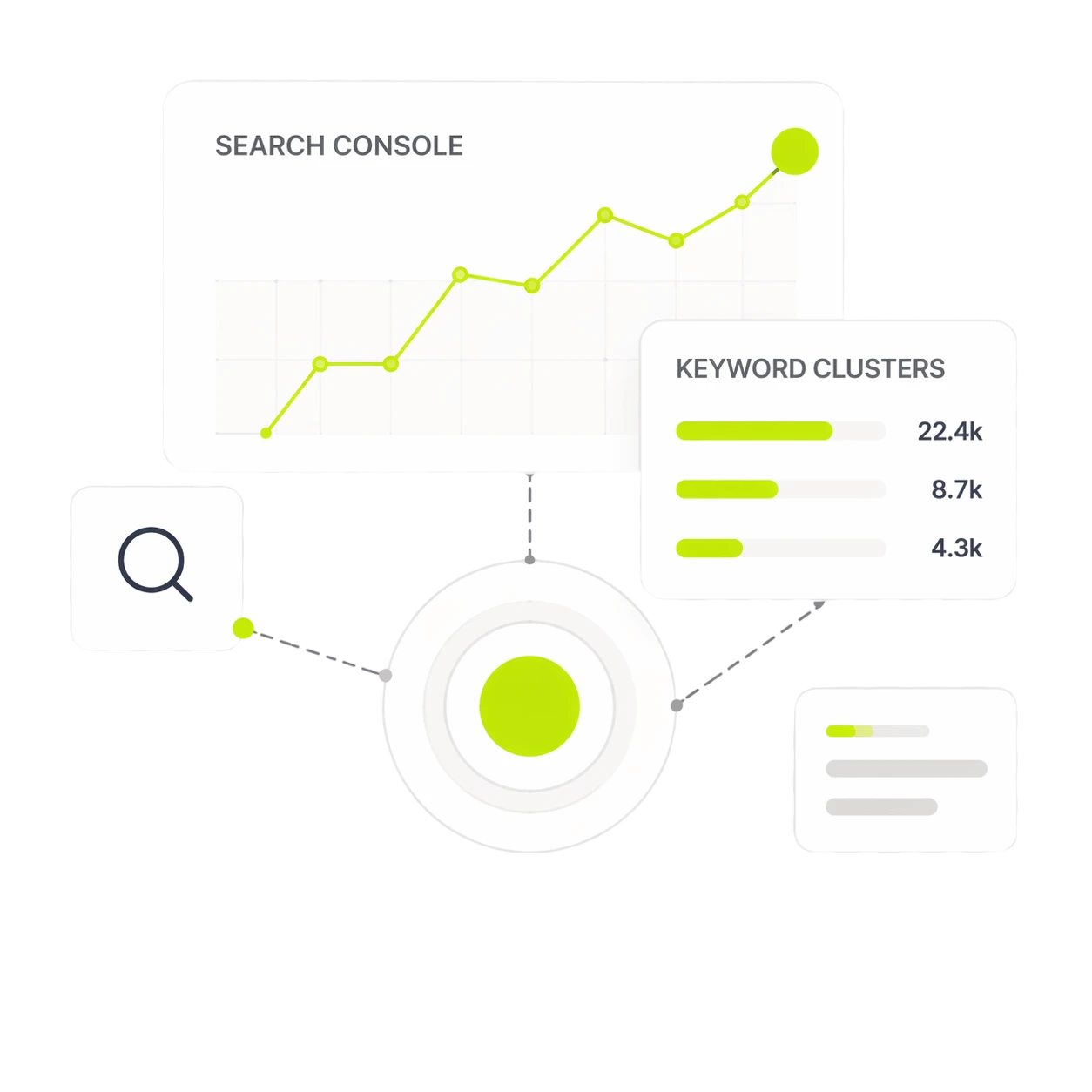
Before you generate a single AI content brief, open Google Search Console . The data already sitting in your Performance report tells you more about what your site should target next than any AI-generated keyword list.
Read GSC Before You Write
GSC shows you the queries your pages already appear for, even without clicks. A page ranking at position 14 for a high-volume query is not a new content opportunity—it is an optimization target. A cluster of informational queries getting impressions but no clicks often points to a title or meta description problem, not a content gap. A topic that is completely absent from your impressions data with obvious commercial potential signals genuine new content work.
Sort your queries by impressions descending, then filter for positions between 8 and 25. These are your highest-leverage optimization targets because the ranking signal is already there—you just need to strengthen the page to move it up. AI tools can help you identify what is missing from those pages compared to current top-ranking results, but the prioritization decision belongs to the data.
Separate Optimization from Net-New Creation
Most AI-assisted SEO programs make the same mistake: they default to creating new pages when the bigger opportunity is improving what already exists. Before generating new content at scale, categorize your existing pages into three buckets:
- Update candidates — pages with impressions but declining clicks, outdated information, or thin content that underperforms its ranking potential
- New content targets — topics with clear search demand that your site has no meaningful coverage of
- Cannibalization risks — multiple pages competing for the same query cluster, splitting authority and confusing search engines
Running a quick cannibalization check before producing AI content briefs is one of the most underused steps in SEO workflows. Two pages targeting near-identical intent will compete with each other in a way that hurts both. GSC’s query-to-URL mapping makes it straightforward to identify these conflicts before they compound.
Use AI After the Data Work, Not Instead of It
Once you have a prioritized list of optimization targets and new content opportunities grounded in real GSC queries, that is the right moment to bring in AI. Use it to analyze SERPs for your priority keywords, identify information gaps between your pages and top-ranking results, draft outlines that map to the intent patterns you have already validated from the data. Keyword clustering with Google Search Console data becomes significantly more useful at this stage because you are grouping real queries from your actual impressions, not hypothetical keyword lists.
Search Intent and Semantic Coverage Are the Core Content Foundation
Search intent is the one constraint that AI cannot override. A page that does not match what searchers actually want will not rank, regardless of how well-written or semantically rich the content is.
Map Pages to Intent Before Touching Content
Every page should have a clear primary intent assignment: informational, commercial, transactional, or navigational. This sounds obvious, but mixed-intent pages are common in AI-generated content because LLMs default to covering a topic broadly rather than matching a specific search behavior.
Informational pages should answer a question or explain a concept. Commercial pages should help readers evaluate options. Transactional pages should facilitate a decision or action. Navigational pages should route users to the right destination efficiently. When a single page tries to do two of these at once, it typically does neither well enough to rank.
Cluster Queries, Then Validate Against SERPs
AI is effective at clustering semantically related queries. It can group variations, synonyms, and related subtopics quickly. But AI-generated clusters need one validation step that often gets skipped: SERP similarity checking.
Two queries belong in the same content cluster only if the same page could realistically serve both, which you can verify by checking whether the top-ranking results overlap significantly. If Google is returning different page types for two queries—a forum thread for one and a product page for another—they likely represent different intents even if they share similar language.
SERP-validated clusters tell you whether one page can target a group of queries or whether you need separate pages. This step prevents the common mistake of cramming unrelated intents into a single article and underserving all of them.
Add Information Gain: The Differentiator AI Cannot Fake
Information gain is what separates rankable content from AI-generated noise. It is the original perspective, concrete example, proprietary data point, or practical process step that users cannot get from every other page on the topic.
Information gain takes different forms depending on the content type:
- Process screenshots or walkthroughs that show exactly how something works, not just that it works
- Real data or benchmarks from your own experience or analysis, not repackaged industry statistics
- Specific examples tied to actual use cases your audience recognizes
- Expert context that reframes conventional wisdom or adds nuance the standard answer lacks
- Templates, checklists, or tools that give readers something to use directly
AI can help structure and draft content efficiently, but it cannot supply this layer. The information gain has to come from your team’s actual knowledge and experience. Pages that rely entirely on AI-generated content tend to look fine in isolation but converge toward the median—which is precisely the signal Google uses to identify low-value content at scale.
High-Quality Content Still Requires Human Judgment
AI genuinely helps with SEO content production. It summarizes SERPs faster than any manual review process, generates outlines that surface structural patterns in top-ranking pages, flags information gaps between your draft and competing content, and speeds up the revision cycle considerably. For teams managing dozens of pages at a time, these efficiency gains are real and worth capturing.
But several parts of the content process should not be delegated to AI, and mistaking efficiency for quality control is where most AI-assisted SEO programs go wrong.
Where AI Helps
SERP summarization: AI can quickly digest the top 10 results for any query, identify structural patterns (listicle vs. how-to vs. comparison), note which subtopics consistently appear, and flag what the bottom half of the results is missing. This turns hours of manual research into minutes of structured input.
Outline generation: Once you have a validated intent and query cluster, AI drafts outlines that reflect common structural patterns for that content type. These are useful starting points, not finished structures—a human editor should adjust for brand voice, audience sophistication, and specific information gain opportunities.
Gap identification: At revision stage, AI tools can compare your draft against top-ranking pages and flag missing subtopics, thin sections, or structural weaknesses. This catches issues that human writers often miss because they are too close to their own content.
Draft acceleration: AI can produce first drafts that a skilled editor can shape into quality content significantly faster than writing from scratch. The key word is “editor”—someone who rewrites for accuracy, adds specific examples, and strips generic phrasing.
Where Humans Must Lead
Accuracy and fact-checking: AI systems hallucinate. They cite incorrect statistics, misattribute quotes, and sometimes invent sources that do not exist. Every factual claim in AI-assisted content needs human verification before publication. This is non-negotiable for E-E-A-T and user trust.
First-hand examples and brand perspective: If your content looks exactly like a cleaned-up AI output, it adds no differentiation. The examples drawn from your team’s experience, the client scenarios you have actually navigated, the opinions your subject matter experts actually hold—these are what separate your content from the commodity layer.
Prioritization: AI cannot tell you which content is worth building right now based on your specific business goals, audience stage, or competitive positioning. That decision requires understanding your funnel, your team’s capacity, and what your existing pages need before you add more.
Editorial judgment: Tone, depth calibration, pacing, when to use a list versus a paragraph, what to cut—these are the editing decisions that determine whether content is actually useful or just complete.
A practical QA checklist for AI-assisted content before publishing should include: factual accuracy check on all statistics and claims, a review for brand voice and specific examples, intent match confirmation against the target query, readability review for natural sentence structure, a check that no key information gain element was flattened into generic language, and an internal link review to connect the page to the rest of your site’s content system.
The SEO content brief workflow used at Dango covers the brief interpretation process, on-page structural decisions, and editorial standards that map to this kind of quality-first approach to AI-assisted production.
Technical SEO Makes Your Site Understandable to Search Engines and AI Systems
Technical SEO has always been the foundation beneath content. In the AI era, it has gained an additional dimension: your site needs to be accessible not just to Googlebot, but to the growing range of AI crawlers that feed language model training pipelines and real-time content retrieval systems.
Crawl Paths, Sitemaps, Canonicals, and Indexability
A page that cannot be crawled cannot rank. That sounds obvious, but crawl budget and access issues remain among the most common technical problems found in site audits.
Crawl paths should be clear and shallow. Important pages should be reachable within three clicks from the homepage. Deep orphan pages—those with few or no internal links—get crawled infrequently and indexed inconsistently.
XML sitemaps should list every page you want indexed and nothing you do not. Broken URLs, redirected pages, and noindex pages in your sitemap create confusion for crawlers and waste crawl budget on pages that should not receive attention.
Canonical tags prevent duplicate content from splitting ranking signals. If you have multiple URLs that serve similar or identical content (parameter variations, print versions, pagination), canonical tags tell search engines which version to treat as authoritative.
Indexability audits should check for pages mistakenly blocked by noindex directives—a common problem when staging environment settings get accidentally deployed to production.
Robots.txt and LLM Crawler Access
This is where many site owners are working from incorrect assumptions in 2026. When you want AI tools to analyze your content for optimization workflows, you need to verify that the relevant crawlers can actually access your pages.
Several AI crawlers use agents that differ from Googlebot. GPTBot ( OpenAI crawlers ), ClaudeBot (Anthropic), PerplexityBot, and Google-Extended all use distinct user-agent strings. If your robots.txt contains broad disallow directives—especially entries like Disallow: / or wildcard blocks on certain paths—you may be blocking AI systems from reading your content even while Googlebot retains full access.
To check your crawler access situation:
- Open your
robots.txtfile directly atyourdomain.com/robots.txt - Search for directives targeting
GPTBot,ClaudeBot,Google-Extended, andPerplexityBot - If these agents are blocked and you want AI systems to train on or cite your content, update the directives accordingly
- Use Google’s Robots.txt Tester in Search Console to validate changes before deploying
The strategic question—whether you want to allow or block AI training crawlers—is a business decision that depends on your content’s value and competitive sensitivity. But if your current robots.txt was written before these agents existed, it may be producing unintended blocking that hurts your visibility in AI-powered search experiences.
Core Web Vitals, Mobile Usability, and Clean HTML
Core Web Vitals (LCP, INP, CLS) are ranking signals and user experience indicators. Pages that load slowly, shift visually during load, or respond sluggishly to interactions provide poor user experiences that search engines penalize at the margin.
Mobile usability matters because the majority of search queries happen on mobile devices. Pages that render poorly on small screens—with unreadable text, overlapping elements, or broken navigation—will underperform their content quality.
Clean HTML structure means headers follow a logical hierarchy (one H1, organized H2/H3/H4 nesting), images have descriptive alt text, links have descriptive anchor text rather than “click here,” and there are no broken internal or external links degrading crawl quality.
These technical elements are not glamorous, but they determine whether the content work you do actually gets indexed and served.
Structured Data and Schema Markup Help Machines Parse Your Content
Schema markup translates your content into structured data that both search engines and AI systems can parse without ambiguity. It tells crawlers not just what words are on a page, but what those words mean—whether the page is an article, a review, a how-to guide, or a software product.
Schema Types That Matter Most for AI SEO Content
Article — The baseline for editorial content. Specifies headline, author, datePublished, dateModified, and publisher. This is the minimum you should have on every blog post.
FAQPage — Marks up question-and-answer content so search engines can surface your answers directly in search results and AI Overviews. Pages with FAQ schema have stronger candidacy for featured snippets and zero-click formats.
HowTo — Structures step-by-step processes in a machine-readable format. Useful for guides and walkthroughs that AI systems are likely to surface as direct answers.
Organization and WebSite — Establishes entity-level information about your brand: name, URL, logo, social profiles, and contact information. This supports knowledge graph association and E-E-A-T signals.
BreadcrumbList — Communicates page hierarchy to search engines and enables breadcrumb display in SERPs, which helps CTR and crawl path clarity.
SoftwareApplication — For SaaS and tool pages, marks up the application’s name, category, operating system, price, and aggregate rating if applicable.
JSON-LD Example for an Informational AI SEO Guide
The recommended format for structured data is JSON-LD placed in the <head> of the page. Here is a working example for an informational guide like this one:
      {
  "@context": "https://schema.org",
  "@graph": [
    {
      "@type": "Article",
      "@id": "https://blog.dango.sh/what-elements-are-foundational-for-seo-with-ai#article",
      "headline": "What Elements Are Foundational for SEO with AI? A GSC-First Framework",
      "description": "A practical framework covering the foundational SEO elements for AI-assisted search visibility, from GSC data to schema, technical checks, and measurement.",
      "datePublished": "2026-05-11",
      "dateModified": "2026-05-11",
      "author": {
        "@type": "Person",
        "name": "Vanessa",
        "url": "https://blog.dango.sh"
      },
      "publisher": {
        "@type": "Organization",
        "name": "Dango",
        "url": "https://dango.sh",
        "logo": {
          "@type": "ImageObject",
          "url": "https://dango.sh/logo.png"
        }
      },
      "mainEntityOfPage": {
        "@type": "WebPage",
        "@id": "https://blog.dango.sh/what-elements-are-foundational-for-seo-with-ai"
      }
    },
    {
      "@type": "FAQPage",
      "mainEntity": [
        {
          "@type": "Question",
          "name": "Is AI SEO different from traditional SEO?",
          "acceptedAnswer": {
            "@type": "Answer",
            "text": "The foundations are the same—crawlability, relevance, authority, and usefulness. AI changes how efficiently you can execute against those foundations, but the ranking factors themselves remain consistent."
          }
        },
        {
          "@type": "Question",
          "name": "Do I need schema markup to appear in AI Overviews?",
          "acceptedAnswer": {
            "@type": "Answer",
            "text": "Schema is not a hard requirement, but structured data—especially FAQPage, HowTo, and Article schema—makes your content easier for AI systems to parse and cite accurately, which improves candidacy for AI Overview inclusion."
          }
        }
      ]
    },
    {
      "@type": "BreadcrumbList",
      "itemListElement": [
        {
          "@type": "ListItem",
          "position": 1,
          "name": "Blog",
          "item": "https://blog.dango.sh"
        },
        {
          "@type": "ListItem",
          "position": 2,
          "name": "SEO Strategy",
          "item": "https://blog.dango.sh/seo-strategy"
        },
        {
          "@type": "ListItem",
          "position": 3,
          "name": "What Elements Are Foundational for SEO with AI",
          "item": "https://blog.dango.sh/what-elements-are-foundational-for-seo-with-ai"
        }
      ]
    }
  ]
}
Validating Your Structured Data
Use two tools in sequence:
- Google’s Rich Results Test (
search.google.com/test/rich-results) — paste your URL or code snippet to check eligibility for rich result types and see any detected errors or warnings - Schema.org Markup Validator (
validator.schema.org) — validates the JSON-LD against the Schema.org specification for structural correctness
Run both tools after any schema update. Common errors include missing required properties, incorrect @type values, and date formatting that does not match ISO 8601 standards.
Authority, E-E-A-T, and Trust Signals Matter More in AI Search
Google’s E-E-A-T framework—Experience, Expertise, Authoritativeness, and Trustworthiness—was already important before AI. In AI search, it matters more because AI systems are attempting to assess not just content quality but source credibility when deciding what to surface or cite.
Show Who Created the Content and Why They Are Qualified
Author attribution is a concrete E-E-A-T signal. Blog posts should include the author’s name, a brief bio that establishes relevant expertise or experience, and ideally a link to an author page that aggregates their published work. This is not just about search signals—it is about giving readers a reason to trust what they are reading.
For content about SEO and AI, relevant qualifications include specific platforms worked with, quantified results achieved, industries served, and years of experience. Vague claims like “SEO expert” add less signal than concrete specifics like “managed technical SEO for 40+ B2B SaaS sites.”
Support Claims with Evidence
Every significant claim should have a supporting signal: a specific example, a screenshot, a cited source, or original data. This is where AI-generated content most frequently falls short—it makes accurate-sounding generalizations that lack the evidence layer that both users and AI systems look for when assessing reliability.
Original analysis is particularly valuable because it cannot be replicated from any other source. If you have GSC data showing a pattern, a client result that demonstrates a concept, or a test outcome from your own site, that evidence is uniquely yours and significantly more trustworthy than a restatement of general SEO advice.
Build Topical Authority Through Connected Pages
A single authoritative article does not make a topically authoritative site. Topical authority accumulates through a connected cluster of pages that collectively cover a topic in depth from multiple angles: foundational explainers, specific how-to guides, tool comparisons, case studies, and advanced playbooks.
When AI systems and search engines encounter a site with strong topical coverage—where following internal links consistently leads to relevant, high-quality content—they treat that site as a reliable source for the topic. When they encounter an isolated article on a site that otherwise covers unrelated topics, the authority signal is weaker even if the article itself is excellent.
Internal Linking Turns Individual Pages into a Search Visibility System
Internal links perform two functions simultaneously: they distribute PageRank across the site, and they tell search engines how your pages relate to each other. For AI SEO programs generating content at scale, a deliberate internal linking system is what prevents the site from becoming a pile of disconnected articles.
Connect Foundational Guides to Specific Implementation Pages
The internal linking pattern that produces the most SEO value is the hub-and-spoke model: broad foundational guides linking to specific implementation pages, which link back to the hub and to each other where relevant.
This article, for example, serves as a foundational layer that should connect to more specific pages on each element it covers. For teams that need the full stack—keyword research, clustering, CMS workflows, and AI generation—a programmatic SEO tools comparison helps with platform selection at scale. For advanced implementation details around crawl paths, template design, and technical QA in SaaS contexts, the programmatic SEO for SaaS workflows playbook covers the specifics.
For teams evaluating AI platforms for their content workflow, AI SEO tools for content workflows covers use-case breakdowns and criteria for tool selection—a different question than what foundational elements to build on, but a natural next step once the foundation is in place.
Choose Anchor Text Based on Real User Queries
Generic anchor text (“click here,” “read more,” “learn more”) wastes the signal value of internal links. Descriptive anchor text that reflects how users search for the destination page passes topical relevance and reinforces the destination page’s keyword targeting.
Anchor text should be:
- Descriptive of the destination page’s primary topic
- Varied across links pointing to the same page (using natural synonyms and related phrases rather than repeating the exact same anchor text)
- Contextual to the surrounding paragraph so the link reads naturally within the prose
Build Hub-and-Spoke Paths
Map out the content system you are building before you start producing articles. Identify the broad foundational guides (hub pages) and the specific implementation articles (spokes). Make sure every spoke links back to its hub, that hubs link to all their relevant spokes, and that related spoke pages link to each other where genuinely relevant.
This architecture creates multiple crawl paths to every important page, concentrates topical authority around your hub pages, and makes it possible for users and AI systems to navigate from a broad question to a specific answer within your site’s content—exactly the behavior that builds topical authority over time.
Measure AI SEO Foundations with the Right Metrics
Measurement in AI-era SEO requires tracking both the traditional signals that confirm whether your foundations are working and newer signals that reveal performance in AI-generated search experiences.
Traditional Metrics Remain the Core
Impressions — How often your pages appear in search results for any query. Growing impressions indicate expanding topical coverage and improving indexation.
Clicks — Actual visits generated from search. CTR (clicks divided by impressions) reveals whether your titles and meta descriptions are compelling enough to earn the click when you do appear.
Average position — Where your pages rank for their target queries. Combined with impression data, this tells you whether pages need further optimization or are ready to scale.
Indexed pages — The number of pages Google has indexed from your site. Unexplained drops in indexed pages signal crawl or indexation problems that need immediate investigation.
Crawl errors — 404 errors, server errors, and redirect chains detected in GSC’s Coverage report. These need regular monitoring, especially for sites producing content at volume.
AI-Era Metrics
AI Overview appearances — Google has begun incorporating AI Overview data into Search Console for some queries. Track which queries trigger AI Overviews for your target keywords, and whether your pages are cited within them. Pages with strong E-E-A-T, clear structured answers, and FAQ schema tend to show stronger AI Overview candidacy.
Referral traffic patterns — Monitor referral traffic from platforms like Perplexity, ChatGPT’s browse feature, and similar AI-powered discovery tools. An increase in referral traffic from these sources suggests your content is being cited by AI systems in response to user queries.
Branded query growth — When AI systems consistently cite your site, users begin searching for your brand directly after discovering you through AI-generated answers. Growing branded impression volume is an indirect signal of increasing AI-assisted discovery.
Assisted discovery — Look for patterns in your analytics where users arrive via channels other than organic search but report finding you through a search or AI tool. Session paths that start on informational or AI-relevant pages and convert downstream indicate that your AI SEO foundations are generating real business value.
Monthly Foundation Audit Using GSC and Site Crawl Data
A repeatable monthly audit keeps the foundation healthy as content scales. The process:
- GSC Performance check — Review impression trends by page and query cluster; flag pages with declining CTR or average position
- Coverage report review — Check for new crawl errors, excluded pages, and indexation gaps
- Core Web Vitals review — Confirm no new pages have entered the “Poor” performance band
- Internal link health — Run a crawl (Screaming Frog, Ahrefs Site Audit, or equivalent) to detect broken internal links and orphan pages created by recent content additions
- Schema validation — Spot-check new pages for structured data errors using Rich Results Test
- AI visibility check — Manually search 10–15 priority keywords to observe AI Overview presence and whether your pages are cited
This audit takes two to four hours per month for most sites and catches compounding issues before they significantly affect performance.
30/60/90-Day Checklist for Building an AI SEO Foundation
Structure the foundation-building process in three distinct phases. Each phase builds on the previous one, moving from audit and assessment through targeted improvement and into scaled execution.
Days 1–30: Audit, Diagnose, and Prioritize
GSC data audit:
- Connect GSC and export the last 12 months of query and page performance data
- Identify all pages with impressions but positions below 10 (optimization targets)
- Flag pages with declining CTR trend over the past 90 days
- Identify the top 20 queries with meaningful impressions and no corresponding optimized page
Technical accessibility audit:
- Crawl the full site with a crawler tool; document all 4xx errors, redirect chains, and orphan pages
- Review robots.txt for unintended blocking of Googlebot and AI crawlers (GPTBot, ClaudeBot, Google-Extended, PerplexityBot)
- Check Core Web Vitals in GSC’s Experience report; flag any pages in “Poor” status
- Confirm XML sitemap is current, error-free, and submitted in Search Console
- Review structured data coverage; identify which page types lack schema markup
Content audit:
- Identify cannibalization conflicts (multiple pages competing for the same query cluster)
- Assess top 10 highest-impression pages for information gain quality and intent match
- Document internal linking gaps (pages with fewer than 2 inbound internal links)
E-E-A-T check:
- Confirm every published piece has clear author attribution
- Review author bios for specificity of credentials
- Check whether key factual claims have supporting evidence
Days 31–60: Targeted Improvement on Priority Pages
Intent and content quality:
- Update the top 5 optimization-target pages: improve intent match, add information gain, update any outdated information
- Resolve all cannibalization conflicts identified in Phase 1 (consolidate, redirect, or differentiate)
- Add FAQ sections to informational pages that lack them; validate FAQPage schema
- Improve title tags and meta descriptions on pages with low CTR despite decent position
Schema implementation:
- Add Article schema to all blog posts missing it
- Implement FAQPage schema on the 10 highest-impression informational pages
- Add Organization and WebSite schema to the homepage if absent
- Validate all new schema with Rich Results Test
Internal linking:
- Add inbound internal links to all orphan pages identified in Phase 1
- Update the 10 highest-traffic pages to include contextual links to related new or underlinked pages
- Build or refine the hub-and-spoke structure for your primary topic cluster
Technical fixes:
- Resolve all 4xx errors found in the Phase 1 crawl
- Fix Core Web Vitals issues on high-priority pages
- Clean up redirect chains that exceed two hops
Days 61–90: Scale, Measure, and Refine
Content scaling:
- Produce briefs for the top 20 new content opportunities identified from GSC data
- Use AI-assisted drafting for new articles, applying the human QA checklist before publication
- Build a refresh queue for aging content based on declining impression or position trends
- Ensure every new article is connected into the internal linking system before publishing
Workflow refinement:
- Document the brief-to-publish workflow including AI tool touchpoints and human review checkpoints
- Identify which AI tool handles which workflow step (clustering, brief generation, drafting, QA)—and where the workflow has gaps
Measurement:
- Set up monthly foundation audit as a recurring process
- Track AI Overview appearances for your 20 highest-priority queries
- Monitor referral traffic from AI-powered platforms in your analytics tool
- Review indexed page count trend; investigate any drops
For teams ready to scale this process beyond individual article production, programmatic SEO for SaaS workflows covers the template design, crawl path architecture, and QA systems needed to produce and maintain pages at volume without sacrificing quality.
Frequently Asked Questions
Is AI SEO different from traditional SEO?
The foundational elements are the same: crawlability, relevance, authority, usefulness, and measurement. What AI changes is execution—how quickly you can produce content, identify gaps, cluster keywords, and revise pages. AI-assisted SEO that skips the foundational work produces faster output that does not rank. AI applied on top of a sound foundation accelerates results meaningfully.
Can AI-generated content rank in Google if it is edited by humans?
Yes. Google evaluates content based on quality, usefulness, and E-E-A-T signals—not on whether a human or AI produced the first draft. AI-generated content that has been thoroughly edited for accuracy, specificity, brand voice, and genuine information gain can rank as well as entirely human-written content. The problem is when “edited” means a light pass for grammar rather than substantive human judgment applied to the accuracy and depth of the content.
Do I need schema markup to appear in AI Overviews?
Schema markup is not a hard technical requirement for AI Overview inclusion, but it significantly improves your candidacy. FAQPage and HowTo schema structure your content in a format that is easy for AI systems to parse and cite. Article schema confirms authorship and publication dates. Structured data reduces the ambiguity that AI systems face when interpreting what a page is about and whether it is credible—which matters when competing for citation in generated answers.
How do I know whether AI crawlers can access my website?
Open your robots.txt file at yourdomain.com/robots.txt and look for directives targeting GPTBot, ClaudeBot, Google-Extended, PerplexityBot, and Amazonbot. If any of these agents are listed with Disallow: / or similar blocking directives, AI crawlers cannot access your content. Google’s Robots.txt Tester in Search Console lets you test specific user agents against your current rules. If you want AI systems to index and potentially cite your content, ensure these agents are not blocked.
Should small websites focus on GEO or traditional SEO first?
Traditional SEO first—always. GEO (Generative Engine Optimization) is significantly harder to influence directly and depends on your site already having some level of authority and topical credibility. A small site with weak technical foundations, thin content, and few quality backlinks will not gain meaningful GEO traction regardless of how well the content is structured for AI citation. Build the traditional SEO foundation first—crawlability, indexed content, topical coverage, E-E-A-T signals—and GEO visibility will follow naturally as that foundation strengthens.
What SEO tasks should not be fully automated with AI?
Fact-checking and accuracy verification should never be fully automated. Strategic prioritization—deciding which content to build next based on business goals and competitive context—requires human judgment. First-hand examples and original analysis cannot be generated by AI. Editorial decisions about tone, depth, and what to cut are best made by a human editor. Outreach and relationship-building for link acquisition is a human activity. And the final quality review before any page publishes should always involve a human who can assess whether the page genuinely helps the reader or just appears to.
How often should an AI SEO foundation audit be completed?
Monthly for most sites actively producing content. The audit does not need to be exhaustive every month—a focused GSC performance check, coverage report review, and crawl error scan takes a few hours and catches compounding issues early. A more comprehensive audit covering internal linking architecture, schema coverage, E-E-A-T signals, and content quality across all pages makes sense quarterly. Sites scaling aggressively through programmatic content production should run technical checks bi-weekly during active publishing phases.
Which GSC metrics are most useful for AI-assisted SEO planning?
Impressions by query and page for identifying optimization targets and gap opportunities. Average position filtered to positions 8–25 for prioritizing quick-win updates. CTR analysis on high-impression pages to identify title and meta description improvements. Page-level coverage data to detect indexation problems. And the queries report filtered by “new” to identify emerging topics your site is beginning to rank for before competitors do. These signals, used together, turn GSC from a reporting tool into a content planning system.
Can internal links improve visibility in AI search results?
Indirectly, yes. Internal links improve crawl path efficiency, help distribute PageRank to underlinked pages, and signal topical relationship between pages—all of which strengthen the overall authority of your site on a given topic. AI systems that assess topical authority by crawling or indexing site content are more likely to treat a well-internally-linked cluster as a reliable source than a collection of orphan pages. Internal links also help AI systems understand which pages are most authoritative within a topic, which influences citation decisions in AI-generated answers.