Picking the wrong SEO writing service is an expensive lesson. You pay for articles, wait months for results, and eventually realize the content looks polished but ranks nowhere. The problem is rarely the writing itself — it is the absence of a structured workflow behind it. No GSC-informed keyword research, no content briefs grounded in real SERP data, no cannibalization checks, no post-publish measurement. Just words on a page.
This guide is for SEO professionals, content managers, B2B marketers, and agency teams who want to evaluate seo content services with clear criteria rather than vague promises. Whether you are considering full outsourcing, an in-house system, or a combination of both, the framework here will help you ask better questions before you sign a contract.
What Is an SEO Writing Service?
An SEO writing service is an external provider — an agency, a managed freelancer platform, or a content studio — that produces articles, landing pages, guides, and other web content specifically optimized for organic search. The deliverable is not just readable prose; it is structured content designed to rank for specific queries, earn clicks, and support a site’s broader topic authority.
How SEO Writing Differs From General Copywriting
General copywriting prioritizes persuasion and brand narrative. SEO writing does that too, but it starts from a completely different place: search demand. A good SEO writer reverse-engineers what a target audience is already looking for in Google, maps that to a strategic keyword cluster, and then writes content that satisfies that intent better than any competing page.
This requires skills that go beyond grammar and tone. It means interpreting SERP layouts to understand what Google rewards for a given query, structuring content with the right heading hierarchy, incorporating entities and secondary terms naturally, and knowing how to build internal links that support the page’s authority rather than fragment it.
What Businesses Usually Expect From an SEO Writing Provider
Most teams outsource SEO writing because they need output at a pace their in-house team cannot sustain. The expectation is typically a predictable volume of articles per month, delivered on schedule, optimized for specific keywords, and ready to publish with minimal editing.
Where expectations and reality often diverge: businesses want rankings, but many services only deliver word count. That gap matters a great deal, and it is the central thing this guide helps you identify before you commit.
When Outsourced Writing Makes Sense vs. When to Keep Writing In-House
Outsourcing works well when your content strategy is already defined and you need execution capacity. If you have done your keyword clustering, mapped content gaps, built your internal link structure, and created detailed briefs, a quality writing service can execute reliably.
Keeping writing in-house makes more sense when your content requires deep subject-matter expertise, highly specific brand voice, or real-time responsiveness to product updates. It also makes sense when your team already has a structured SEO content writer workflow that connects GSC data to brief creation to publishing — because that workflow itself is often the differentiator.
What SEO Content Services Should Include
The deliverable list is where you separate services worth buying from those that just produce content. Strong seo content services cover research, structure, execution, and measurement — not just drafting.
Keyword Research Grounded in Search Intent, Not Just Volume
Volume-based keyword selection — picking terms because they show high monthly search numbers — is one of the most common sources of wasted content budget. A term with 12,000 monthly searches and navigational intent will not convert or rank for a B2B SaaS product. Effective keyword research identifies terms where the search intent aligns with what your business offers and where your site has a realistic chance to compete.
Quality providers use a combination of competitive gap analysis, SERP-layout inspection, and — ideally — your own Google Search Console performance report data to surface queries where you already have impressions and could push from page two to page one with a targeted piece of content.
Content Briefs With SERP Analysis, Entities, Internal Links, and Audience Context
A content brief is the document that separates informed SEO writing from keyword stuffing. A thorough brief includes the primary and secondary keywords, a mapped search intent, required headings and subheadings drawn from SERP analysis, key entities Google associates with the topic, links to existing internal pages the writer should reference, and clarity about audience sophistication and brand voice.
Without a brief this specific, writers default to generic structures. Mediocre briefs produce mediocre articles. The brief is where strategy turns into execution.
On-Page Optimization for Headings, Metadata, Structure, and Readability
Every article a service delivers should include an optimized title tag that can influence title links in search results , a meta description, proper H1/H2/H3 hierarchy, keyword placement in the opening paragraph and key subheadings, and a formatting structure that matches how the target SERP is organized. Readability — sentence length, paragraph breaks, scannable subheadings — matters both for users and for how Google evaluates content quality.
These are not optional extras. They are baseline requirements.
Human Editing for Expertise, Accuracy, and Brand Voice
AI-assisted drafting has accelerated content production significantly. But AI output that goes to publish without expert review is a liability: factual errors, generic claims, and a flattened voice that does not reflect your brand. A credible service includes a layer of human editing that verifies claims, adds subject-matter nuance, and calibrates tone.
The editorial step is also where an experienced writer reinforces the entity coverage the brief calls for and checks that internal links appear naturally in context rather than being dropped in at random.
Post-Publish Measurement Using Rankings, Impressions, Clicks, and Conversions
Content performance is not visible on day one. But a serious provider tracks what happens after articles go live. Minimum expectations: position tracking for target keywords, impressions and clicks from Google Search Console , and a defined review window (commonly 60–90 days post-publish) to assess whether a page needs a refresh, additional internal links, or title-tag adjustments.
Services that measure only word count and delivery dates are not optimizing for rankings. They are optimizing for invoice cycles.
The Biggest Problems With Most SEO Writing Services
Understanding where the industry consistently underdelivers is just as important as knowing what good looks like.
Generic Content That Matches Keywords But Misses Real Search Intent
The most common failure is surface-level keyword targeting. An article optimized for “project management software for remote teams” might cover the right vocabulary but still fail to rank because it does not match the actual format Google rewards — which might be a feature comparison or a ranked list, not a long-form narrative. Intent mismatch kills rankings regardless of writing quality.
No Visibility Into How Topics Are Chosen or Prioritized
Many services let clients submit a keyword list and then execute without question. The problem is that client-submitted keywords are often guesses rather than data-driven opportunities. If a service does not audit your GSC data, analyze your existing rankings, or flag cannibalization risks before assigning topics, they are producing content in the dark.
Weak Internal Linking and Poor Cannibalization Checks
New content that ignores a site’s existing topical structure creates problems over time. If two articles target overlapping keyword clusters, they compete with each other and dilute authority. Strong providers map every new piece of content to the site’s existing structure before writing begins, identify which existing pages should link to the new article, and specify those links in the brief.
Internal links are not decoration. They help Google discover pages and understand relationships , while passing authority to newer pages that need it.
Little Proof of Performance After Articles Go Live
Ask a prospective content service to show you a case study where they document rankings before and after publishing a specific article. If they cannot, you are being asked to trust without evidence. Performance data — even from a single example — reveals whether their workflow produces content that actually moves the needle.
Overreliance on AI Without Editorial Review or Subject-Matter Expertise
AI can draft fast. But without human oversight, AI-generated content tends to be structurally correct and factually shaky. Google’s helpful, reliable, people-first content guidance is specifically designed to surface this problem. Services that skip editorial review to cut costs are handing you content risk: thin expertise signals, potential inaccuracies, and a generic voice that competes poorly against content built from genuine expertise.
How to Evaluate an SEO Writing Service Before You Buy
The evaluation process matters as much as the eventual decision. These questions separate credible providers from those who sell deliverables without accountability.
Ask for Sample Briefs, Not Just Writing Samples
A writing sample shows you the output. A content brief shows you the system. Look for briefs that include: primary and secondary keywords, mapped search intent, a detailed heading structure, competitor references, entity lists, specified internal links, and audience context. If a provider cannot share brief examples, their workflow probably starts at the draft stage — which is too late.
Review How They Use First-Party Data Like Google Search Console
Does the provider ask to access your GSC data before choosing topics? Or do they rely exclusively on third-party keyword research tools? First-party GSC data reveals queries where your site already has authority, pages with declining impressions worth refreshing, and cannibalization risks that no external tool can surface. A provider that ignores your GSC data is operating on assumptions.
Check Whether They Map Content to Existing Pages Before Creating New Ones
Before a new article is written, a quality provider should confirm that the target keyword cluster is not already covered by an existing page. This mapping step prevents topic cannibalization and ensures that internal link relationships are planned before writing begins — not retrofitted afterward.
Look for Transparent Revision, Editing, and QA Processes
Revision policies tell you how a provider handles the gap between draft and final. Ask specifically: who does the editing — is it the same writer or a separate editor? Is there a QA checklist before delivery? How many rounds of revision are included? A vague answer here usually means the revision process is informal, which means quality is inconsistent.
Compare Whether They Measure Traffic, Rankings, Leads, or Only Word Count
A provider who tracks rankings, clicks, and lead attribution is operationally different from one who tracks delivery dates. Ask what reporting they provide and how often. If they offer a monthly deliverable summary without any performance data attached, rankings are not actually a shared goal.
SEO Writing Service Pricing: What Affects Cost?
Pricing structures vary widely , and understanding what drives cost differences helps you compare quotes without being misled by surface-level numbers.
Per-Word, Per-Article, Retainer, and Strategy-Plus-Content Models
Per-word pricing (typically $0.08–$0.30 per word for managed services) scales with length but incentivizes volume over quality. Per-article pricing ($150–$800+ per article depending on depth and research requirements) is more predictable and easier to budget. Retainer models ($1,500–$8,000+/month) bundle a set volume of content with strategy, briefs, and revisions. Strategy-plus-content packages add keyword research, brief creation, and performance reporting to the deliverable stack — and cost accordingly.
Why Cheaper Content Often Costs More After Editing and Rework
Budget content services use low per-word rates to attract volume clients. The catch is that their output typically requires substantial editing before it is publishable. When you factor in your team’s time spent revising, the effective cost per quality article often exceeds what a better provider charges upfront. The cheapest bid is rarely the most efficient spend.
What Should Be Included in a High-Quality Content Package
At minimum, a quality package should include: keyword and intent validation, a structured content brief, a human-edited draft, on-page optimization (title tag, meta description, heading structure), and a defined revision cycle. Post-publish reporting and internal link mapping are strong additions. If those elements are not listed explicitly in the scope, assume they are not included.
Questions to Ask Before Signing a Monthly Content Contract
Before committing to a retainer, get answers to these: Who owns the keyword research process? How are topics validated against my existing content? What is the brief format and who writes it? What is the revision limit per article? What reporting do I receive, and how often? What happens if an article does not rank after 90 days?
A Better Workflow: From GSC Data to Published SEO Content
For teams that want more control over content quality and strategy — whether outsourcing or building in-house — a GSC-led workflow provides a repeatable system that compounds over time.
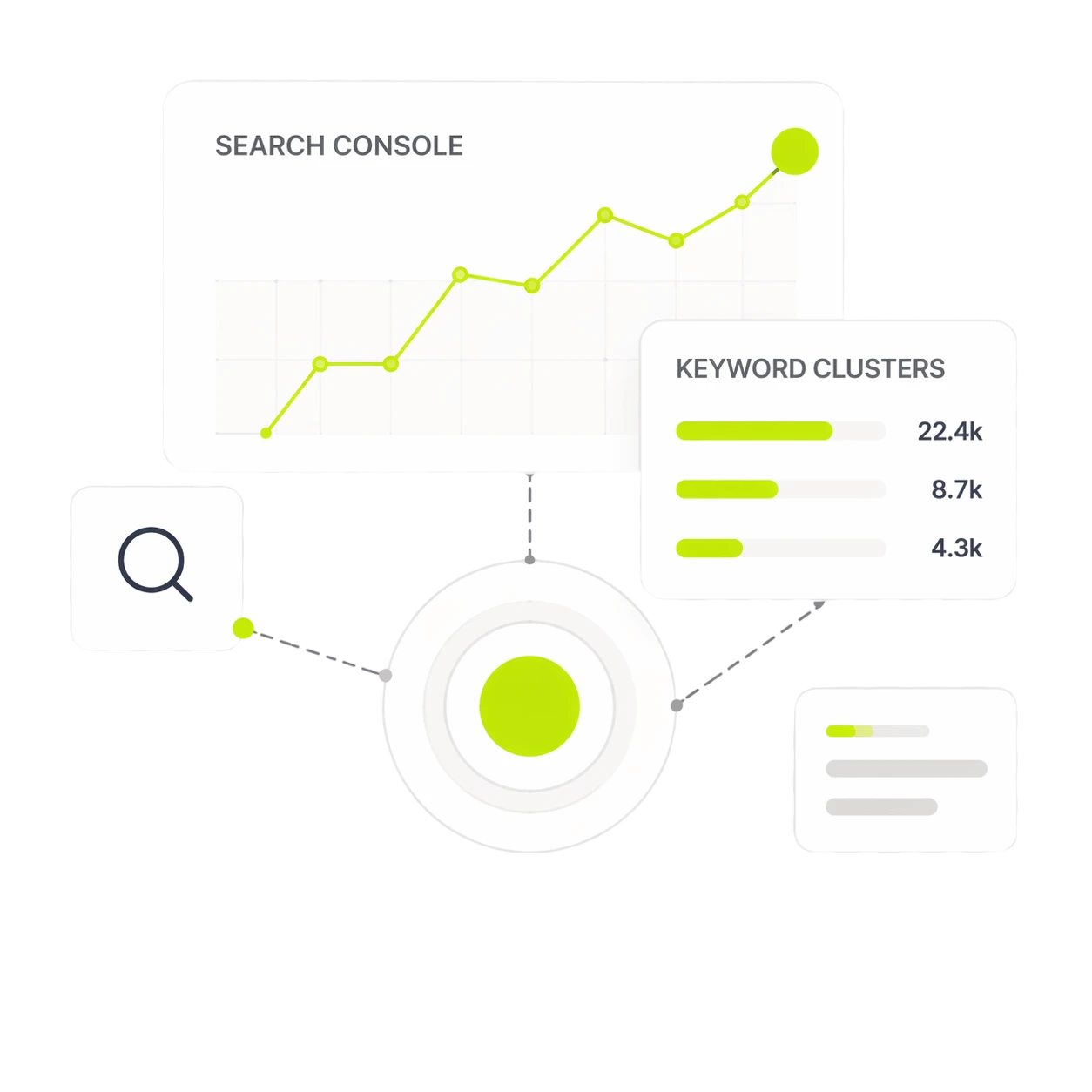
Start With Queries, Impressions, and Ranking Opportunities From Google Search Console
Your GSC data contains the most accurate picture of where your site can grow. Queries ranking between positions 11 and 30 with meaningful impressions are near-miss opportunities: your site has already demonstrated some authority, but the content is not fully meeting search intent. These are better starting points than speculative keyword lists built from competitor analysis alone.
Cluster Related Keywords Before Assigning Topics
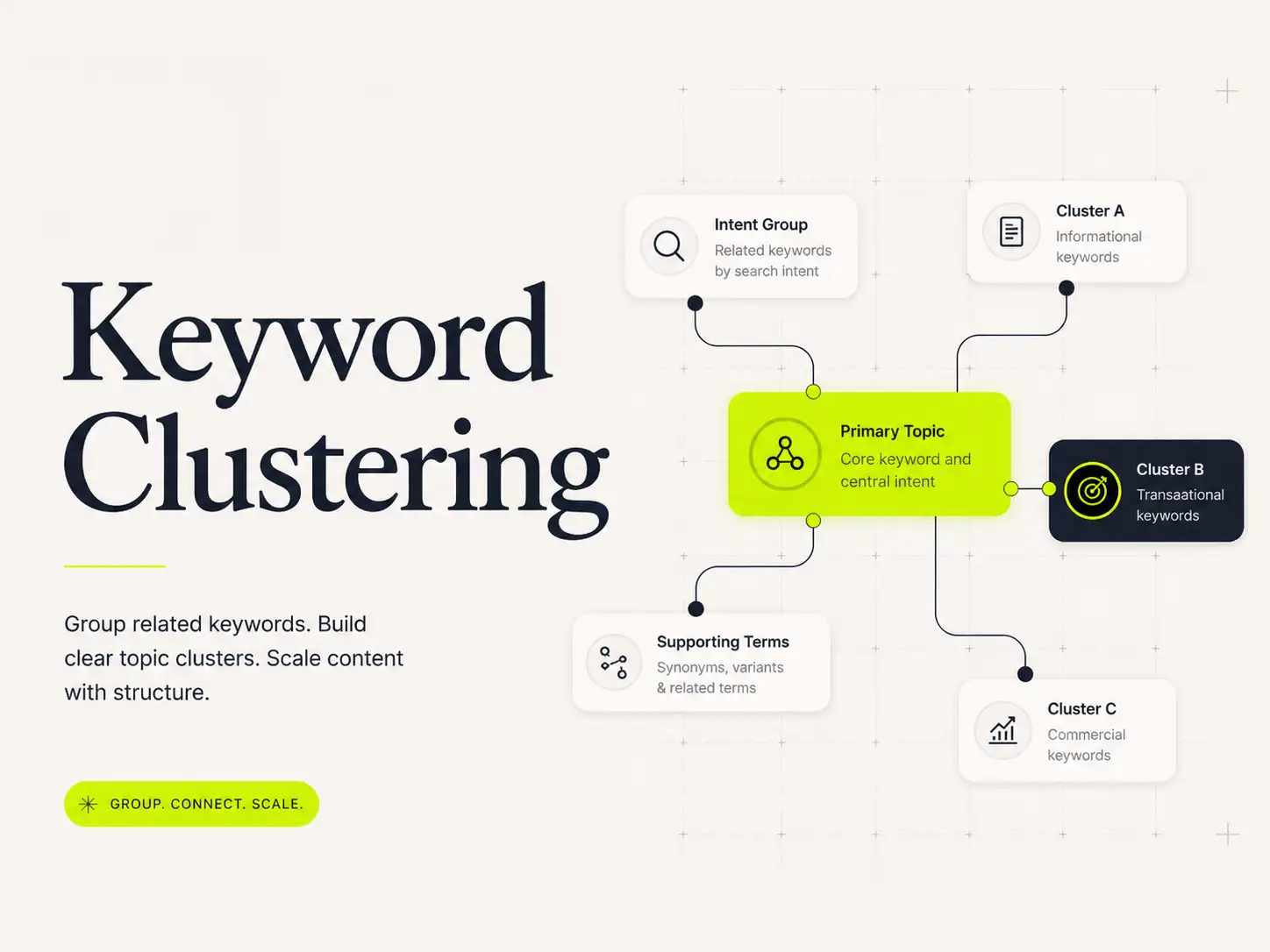
Keyword clustering groups semantically related queries into a single topic before any writing begins. This prevents two problems: creating overlapping articles that compete with each other, and missing the full range of related terms an article could address. A well-constructed cluster becomes the foundation of a brief that covers a topic’s full surface area, not just a single keyword.
The keyword-to-content workflow that connects GSC query data to clusters and then to briefs is one of the most reliable ways to build a publishing queue that prioritizes real opportunities over assumptions.
Generate Briefs That Reflect Existing Site Authority and Internal Links
Briefs built from GSC data and site-aware clustering carry context that generic briefs do not. They identify which existing pages should link to the new article, which entities appear across your top-performing content, and which heading structures consistently appear in the target SERP. That specificity is what makes the difference between a brief a writer can execute confidently and one that produces a generic draft.
Draft Content With Human-in-the-Loop Review
AI accelerates the drafting stage. But human review is not optional — it is where expertise, accuracy, and brand voice enter the content. Google’s guidance on AI-generated content does not ban AI, but it does warn against automation used mainly to manipulate rankings. An editor familiar with the topic, the audience, and the brand validates claims, adds specific examples that AI cannot invent accurately, and ensures the final piece reads like it was written by someone who actually knows the subject.
Refresh and Expand Content Based on Real Performance Data
Publishing is not the end of the workflow. Articles that earn impressions but low clicks often need title tag or meta description adjustments. Articles that rank on page two might need expanded content, stronger internal links, or additional entity coverage. Performance data from GSC drives this iteration — and it is how compounding content growth actually works.
SEO Writing Service vs. AI SEO Platform: Which Should You Choose?
This is not an either/or question. The right answer depends on what your team needs to outsource and what it needs to control.
Use a Writing Service When You Need Full Outsourcing and Editorial Capacity
If your team has no bandwidth for research, brief creation, or editing, a full-service SEO writing provider handles the entire stack. The tradeoff is less strategic control and dependency on the provider’s internal workflow quality.
Use an SEO Platform When You Need Scalable Briefs, Drafts, Clusters, and Internal Links
When strategy and measurement need to stay in-house but execution speed is the constraint, an AI SEO platform gives your team the infrastructure to work faster without sacrificing control. You define the keywords, the platform surfaces clusters and builds briefs, and your team or a contracted writer produces and reviews the drafts.
The landscape of AI SEO tools for content workflows has matured significantly. The better platforms now connect directly to GSC, run clustering automatically, generate structured briefs, and track published content performance — closing the loop that most writing services leave open.
Use Both When Strategy, Writing, and Measurement Need to Work Together
Some teams use an AI platform to handle research, clustering, brief generation, and performance reporting while relying on a writing service or contracted writers for the actual drafting and editorial review. This hybrid approach keeps strategy in-house and scales production without sacrificing data fidelity.
Where Dango Fits in a Modern SEO Content Production Workflow
Dango is not an SEO writing service. It does not employ writers or manage editorial teams. What it does is build the GSC-native infrastructure that makes writing services work better and teams move faster: connecting your GSC data to keyword clusters, generating content briefs from those clusters, surfacing internal link opportunities, and tracking performance after content goes live.
Think of Dango as the planning and execution layer that sits between your GSC account and whoever does the writing — in-house, outsourced, or AI-assisted. Teams using a full SEO content production stack that connects data to briefs to publishing to measurement consistently outperform those that manage each step independently.
SEO Writing Service Evaluation Checklist
Use this framework to compare providers systematically before making a decision.
Questions to Ask Before Hiring a Provider
- Do you request access to our Google Search Console before recommending topics?
- How do you structure content briefs, and can we see an example?
- How do you check for keyword cannibalization across our existing content?
- Who performs editorial review, and what does the QA process look like?
- What does post-publish reporting include, and how often is it delivered?
- How do you handle topics that do not rank within 90 days?
Red Flags That Suggest Low-Quality or Risky Content
Watch for these warning signs: no access to your site or GSC data before topic selection; brief examples that are just keyword lists and word count targets; no mention of internal links in the workflow; revision policies limited to one round with strict time windows; reporting focused exclusively on volume delivered; and AI-generated content with no stated editorial review process.
A Simple Scoring Matrix for Comparing Vendors
Rate each provider 1–5 on these dimensions: keyword research depth, brief quality, editorial process, internal linking strategy, post-publish measurement, transparency and communication, and pricing clarity. A vendor scoring 4–5 across all dimensions is a genuinely strong provider. One scoring well on pricing but poorly on brief quality and measurement should be treated as a volume supplier, not a strategic partner.
The ability to turn keyword clusters into SEO content briefs before writing begins is one of the clearest differentiators between providers operating with a real system and those executing on guesswork.
How to Define Success Before the First Article Is Written
Before any contract begins, align on these specifics: which keywords the first batch of content targets, what baseline ranking position each target keyword holds today, what GSC impressions and clicks currently look like for the topic cluster, what the 90-day performance expectation is, and who owns the decision to refresh or revise underperforming content. Without these definitions, “success” is whatever either party decides it means after the fact.
Final Recommendation: Choose a Workflow, Not Just a Writer
The most common mistake teams make when evaluating SEO writing services is focusing on writing quality before workflow quality. But rankings depend on far more than prose. They depend on research depth, topic clustering, internal link architecture, brief specificity, editorial judgment, and iterative optimization after publish.
A great writer executing a weak brief produces mediocre results. A mediocre writer executing a strong brief — one built from GSC data, SERP analysis, and entity mapping — often produces content that performs. The workflow is the differentiator.
Why Rankings Depend on Research, Structure, Links, and Iteration
An article that ranks is almost always the product of: correct intent targeting, a heading structure that mirrors what Google already rewards in the SERP, internal links from established pages that pass authority to the new content, and at least one round of post-publish optimization based on real impressions and click data. A writing service that does not participate in any of those steps is producing content that may or may not rank — and has no systematic way to know the difference.
How to Combine Human Expertise With GSC-Led Automation
The most scalable content operations today use GSC data to identify and prioritize opportunities, automated clustering and brief generation to accelerate planning, human writers and editors to produce and refine content, and performance data to close the feedback loop. Each element reinforces the others. Skipping any one of them creates a gap that volume alone cannot fill.
Next Step: Build a Repeatable Content System Before Scaling Output
Before increasing publishing frequency, audit what you already have. Map your existing content to keyword clusters. Identify which pages are underperforming and why. Define what a high-quality brief looks like for your specific audience and topic area. Then — whether you outsource the writing or keep it in-house — you will be building on a foundation that compounds rather than one that churns.
Frequently Asked Questions
How much does an SEO writing service usually cost?
Pricing depends heavily on the deliverable scope. Basic per-article services charge $150–$300 for shorter, less researched content. Mid-tier providers offering briefs, editing, and on-page optimization typically charge $350–$800 per article. Full-service monthly retainers that include strategy, keyword research, and reporting range from $2,000 to $10,000+ per month. Per-word pricing ($0.08–$0.25/word) is common but incentivizes length over quality. Always evaluate what is included in the price rather than comparing rates alone.
Is it better to hire a freelancer, agency, or AI-assisted SEO platform?
It depends on what you need to control. Freelancers offer flexibility and cost efficiency but require you to manage briefs, revisions, and strategy independently. Agencies provide managed delivery and strategic oversight but typically cost more and vary significantly in process quality. AI-assisted platforms like Dango give in-house teams the infrastructure to plan, brief, produce, and measure content at scale without outsourcing strategy. Many teams combine an AI platform for planning with freelancers or a writing service for execution.
How many SEO articles should a business publish per month?
There is no universal correct number. The right publishing cadence depends on your team’s capacity to produce quality content, not a target volume. For most B2B and SaaS teams, 4–12 well-researched, brief-driven articles per month outperforms 20–30 generic pieces. Consistent quality at a sustainable pace compounds more reliably than high-volume output that requires constant revision or produces thin content that does not rank.
Can AI-written content rank if it is edited by a human?
Yes, with meaningful caveats. AI-assisted drafts that undergo substantive human editing — fact-checking, expertise layering, brand voice calibration, entity coverage review — can rank and often do. The key variable is editorial depth. AI output that is lightly proofread and published tends to be generic, factually unreliable, and competitively weak. AI output that is treated as a structured first draft and significantly refined by a subject-matter expert can perform very well.
What should I ask for in an SEO content writing sample?
Ask for a sample article alongside the brief that produced it. This lets you evaluate whether the final content actually executed the strategic intent — correct intent targeting, heading structure aligned with the SERP, internal links in context, entity coverage, and on-page optimization. A writing sample alone only tells you what the output looks like. The brief-to-article comparison tells you whether their system works.
How long does it take for SEO writing to improve rankings?
For new articles targeting competitive keywords, three to six months is a realistic minimum before meaningful ranking data is available. Near-miss opportunities — existing pages ranking positions 11–30 that are refreshed with better content — often respond faster, sometimes in four to eight weeks. The timeline depends on domain authority, content quality, internal linking support, and SERP competitiveness. Any provider promising ranking results in days or weeks is not being honest about how search engines work.
Should an SEO writing service handle internal links?
A quality service should at minimum specify which internal links belong in each article as part of the brief. The best providers also audit your existing site structure to identify which established pages should link to the new article, and they either handle that retroactive linking or flag it explicitly in the delivery. Internal links are too structurally important to treat as an afterthought — services that skip them are producing content without properly connecting it to your site’s authority structure.
What metrics should I use to judge SEO content quality?
After 60–90 days post-publish, evaluate: keyword ranking position for the primary and secondary targets, impressions and clicks from Google Search Console, click-through rate relative to average position (below-average CTR at a given position suggests a title or meta description issue), and engagement signals like average session duration and scroll depth if available. For commercial content, lead attribution or assisted conversions are the ultimate measure. Word count, reading level, and “keyword density” are not reliable quality indicators on their own.