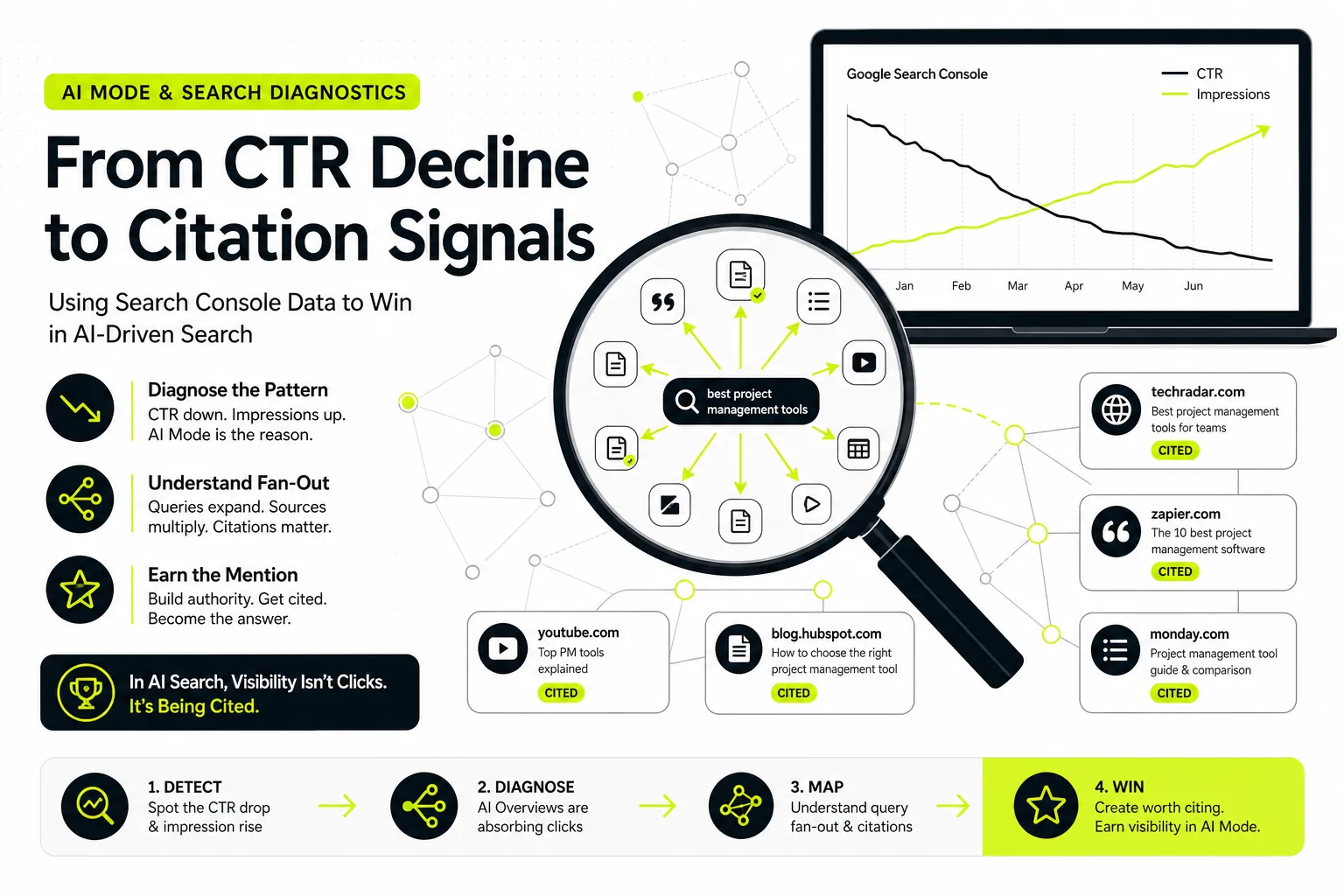
Most coverage of Google AI Mode falls into two camps: Google’s official documentation, which tells you nothing actionable, and vendor think-pieces that tell you to be worried and buy a dashboard. Neither helps you answer the question that actually matters: is AI Mode changing the outcomes of your SEO program, and what should you do differently?
The honest answer lives in your own Google Search Console data, not in industry panic posts. This guide takes Dango’s GSC-first approach to google ai mode seo: first an explanation of how AI Mode actually works mechanically (query fan-out, retrieval-augmented generation, citation selection), then a cause-and-effect model of which queries lose clicks and which retain them, then a concrete diagnostic you can run against your own site this afternoon — and a decision matrix for what to do with what you find.
If you lead SEO at a SaaS company, run growth, or manage client strategies at an agency, you already have everything you need to assess the impact. You just need to know what to look for.
What Google AI Mode Is and How It Differs From AI Overviews
Google AI Mode is a fully conversational search experience — a dedicated tab in Google Search where users ask complex, multi-part questions and receive a synthesized, Gemini-generated answer with inline citations, then continue refining with follow-up questions. It is not a feature bolted onto the results page; it is an alternative results page entirely.
AI Mode vs. AI Overviews vs. traditional blue links
The three experiences differ in how much of the page the generated answer consumes and how much clicking behavior survives:
- Traditional blue links: the user evaluates ten results and clicks. Position drives CTR. This is the world your historical GSC benchmarks were built on.
- AI Overviews: a generated summary appears above organic results for some queries. The blue links still exist below it, but the summary absorbs a share of clicks, especially for simple informational queries.
- AI Mode: the generated answer is the result. Links exist only as citations inside or alongside the answer. There is no fallback list of ten results competing for attention — only the sources the model chose to cite.
The practical difference: in AI Overviews, you can lose some clicks while still ranking. In AI Mode, if you are not cited, you are not present at all.
How Gemini powers conversational, multi-turn search
AI Mode runs on a custom version of Gemini that maintains conversational state. A user might start with “best way to migrate a CMS without losing rankings,” then follow with “what about for a 5,000-page site,” then “which redirects matter most.” Each follow-up inherits the context of the previous turns.
This matters for SEO because multi-turn sessions fragment what used to be one query into a conversation. The queries you see in GSC become less representative of the full intent journey, and the content that wins is content that answers specific sub-questions well, not content that ranks for the broad head term.
Where AI Mode appears today and how fast adoption is moving
AI Mode launched in the US and has been rolling out internationally, with Google progressively pushing it toward more prominent placement — including experiments that surface AI Mode entry points directly in the default search interface. Adoption skews toward complex, exploratory, and comparative queries: exactly the research-stage queries that B2B and SaaS content programs depend on for top-of-funnel traffic.
You don’t need precise adoption percentages to act. What you need is to detect whether your query mix overlaps with AI Mode-prone query types — which is a GSC question, covered below.
How Google AI Mode Actually Works Under the Hood
Understanding the retrieval mechanics is not academic. Every optimization recommendation in this guide derives directly from how AI Mode selects sources.
Query fan-out: one search becomes many sub-queries
When a user submits a question, AI Mode does not run one search. It decomposes the question into multiple sub-queries — a technique Google calls query fan-out — and runs them in parallel against its index. A query like “is HubSpot or Salesforce better for a 20-person sales team” might fan out into sub-queries about pricing tiers, seat minimums, implementation time, CRM feature comparisons, and small-team reviews.
Two consequences follow:
- Pages can be retrieved for sub-queries they never visibly ranked for. A page ranking #15 for the head term can be cited because it answers one sub-question with unusual precision.
- Broad pages lose to specific passages. Fan-out retrieval operates at the passage level. A 4,000-word pillar that covers everything shallowly competes against focused pages that nail individual sub-questions deeply.
This is why AI Mode visibility correlates imperfectly with traditional rankings — and why your top-ranking page is not automatically your most-cited page.
Retrieval-augmented generation and how sources get cited
AI Mode is a retrieval-augmented generation (RAG) system: Gemini retrieves documents from Google’s index, grounds its generated answer in those documents, and cites the sources it relied on. The model doesn’t answer from training memory for fresh or specific topics — it answers from what it retrieves at query time.
Citation selection rewards a particular content profile: clear claims with visible evidence, unambiguous definitions, extractable passages, and consistent entity signals. Pages that hedge, bury answers, or make unsupported claims are harder for a RAG system to use safely, so they get passed over even when they rank. We’ve written in depth about grounding AI content in first-party data — the same grounding mechanics that make AI-assisted content trustworthy are the mechanics that make your pages citable by Google’s own RAG pipeline.
Why ChatGPT, Perplexity, and AI Mode surface different sources
Each answer engine retrieves from a different substrate. AI Mode pulls from Google’s full index with Google’s ranking and quality signals baked in. Perplexity runs its own crawl and retrieval layer with a known preference for recently updated, well-structured sources. ChatGPT’s browsing blends Bing’s index with OpenAI’s own retrieval logic.
The result: the same question gets different citation sets across engines. A page consistently cited in Perplexity may never appear in AI Mode, and vice versa. This is why “AI visibility” as a single number is misleading — and why your Google strategy should be anchored to Google’s signals (and your GSC data) rather than a blended cross-engine score.
The Real SEO Implications of Google AI Mode
Strip away the hype and the google ai mode seo implications come down to a redistribution: clicks shift away from certain query types, citations replace positions as the visibility unit for those queries, and quality thresholds rise because the model only needs a handful of sources per answer.
Which query types lose clicks and which still earn them
Not all traffic is equally exposed. A working impact model by query class:
High click-loss risk:
- Definitional and simple informational queries (“what is X”) — fully answerable in the generated response
- List-style and “best practices” queries where the answer is a synthesizable summary
- Quick factual lookups: pricing ranges, dates, specs, statistics
Moderate risk:
- Comparison queries (“X vs Y”) — AI Mode summarizes, but users researching purchases often click cited sources to verify
- How-to queries with multiple steps — summaries satisfy some users; those executing the task click through
Click-resilient:
- Transactional and navigational queries — users want the destination, not a summary
- Branded queries — AI Mode reinforces rather than replaces brand demand
- Queries requiring tools, templates, calculators, downloads, or interactive elements
- High-stakes decisions (vendor selection, YMYL-adjacent topics) where users verify sources
- Queries answered by genuinely proprietary data the model must cite to use
Map your GSC query portfolio against this model and you have a site-specific exposure estimate instead of a generic fear.
Citations and brand mentions become the new visibility currency
For the exposed query classes, the question shifts from “what position do we hold” to “are we a cited source, and is our brand named in the answer.” A citation in an AI Mode response delivers two things: a possible click (citation links do pass referral traffic, though at lower rates than blue links) and a brand impression in front of a user at the exact moment of research.
Brand mentions compound differently than rankings. When AI Mode repeatedly names your product in answers about your category, that drives branded search demand — which you can measure in GSC. Monitoring where you’re cited across engines is what answer engine optimization tools exist for, but monitoring is the easy half; earning citations is a content-quality problem, not a tracking problem.
Why AI Mode is a stress test that exposes weak content
A traditional SERP has ten slots; mediocre content could survive at position 6 and still collect clicks. An AI Mode answer might cite three to eight sources total. The model has no incentive to cite the fifth-best explanation of a concept — it needs the clearest, best-evidenced one.
This means AI Mode functions as a quality stress test on your content library. Commodity content — the rewritten consensus of the existing top ten, with no original data, examples, or perspective — loses its remaining shelf space. Content with genuine information gain becomes disproportionately valuable, because it’s the only kind a RAG system must cite to include the information at all.
What this means for small sites without established authority
Counterintuitively, fan-out retrieval is partly good news for smaller sites. Because AI Mode retrieves passages for narrow sub-queries, a small site with a deep, specific page can get cited alongside — or instead of — a large publisher’s shallow coverage. You don’t need to outrank the incumbents on the head term; you need to be the best answer to one sub-question they handle generically.
The catch: small sites still need baseline trust signals — clean entity presence, author attribution, evidenced claims, consistent topical depth — because the model deprioritizes sources it can’t verify. The realistic strategy for a small site is narrow topical dominance over broad coverage: own a defensible slice deeply rather than competing thinly everywhere.
Measuring the SEO Impact of AI Mode on Your Own Site
Before changing strategy, measure. The google ai mode seo impact on your site is empirically detectable in Search Console — Google folds AI experience data into GSC performance reports — but only if you segment correctly. Site-wide averages will hide everything.
A GSC diagnostic: spotting impressions-up, clicks-down patterns
The signature of AI-driven click loss is impressions holding or rising while clicks and CTR fall, with position stable. Stable position rules out a ranking problem; the page is still surfaced, but the click behavior around it changed.
Run this diagnostic:
- Open GSC Performance → compare the last 3 months against the same 3 months year-over-year (avoid seasonal noise).
- Filter to your top informational pages, one at a time or by URL folder (e.g.,
/blog/). - Flag every page where: position is flat or improved, impressions are flat or up, and CTR dropped more than ~25% relative.
- Export the queries for flagged pages and tag each by query class (definitional, comparison, how-to, transactional, branded).
If your flagged queries cluster in the high-risk classes from the impact model above, you’re looking at AI-layer absorption, not an algorithmic demotion. That distinction completely changes the correct response — the answer to a demotion is fixing the page; the answer to AI absorption is repositioning what the page is for.
One caveat: GSC currently blends AI experience impressions and clicks into overall search data without a separate AI Mode filter, so this is inference from patterns, not direct attribution. The pattern is still reliable when position is controlled for.
Tracking CTR decay by query class instead of site-wide averages
Site-wide CTR is a useless number in 2026, because the decay is concentrated. Build a simple segmentation:
- Export 12–16 months of query-level GSC data.
- Tag queries by class (a regex pass catches most: queries starting with “what is/how to/best” vs. containing your brand vs. containing “pricing/buy/login”).
- Compute CTR per class per month, holding average position roughly constant within each class.
What you’ll typically find: definitional-query CTR decaying steadily, branded and transactional CTR stable, comparison queries somewhere in between. That curve is your site’s actual AI Mode exposure — and it tells you where defending clicks is futile versus where it’s still worth fighting. If you want tooling that connects this kind of first-party diagnosis to citation tracking and content action, our comparison of SEO software for AI Mode breaks down which platforms are built around real GSC data versus scraped estimates.
KPIs that matter beyond rankings and raw visibility
Rankings remain a leading indicator of retrievability, but they’re no longer the outcome metric. A measurement framework that survives AI Mode:
- Impressions by query class — demand and surface presence, even where clicks decline
- CTR by query class — your decay curve, tracked monthly
- Branded query growth — the downstream effect of being named in AI answers; the single best proxy for AI-driven brand visibility, and it lives in GSC
- Citation frequency — how often your URLs appear as sources in AI Mode/AI Overviews answers for your priority topics (sampled manually or via monitoring tools)
- AI referral traffic — sessions arriving from AI surfaces in your analytics
- Conversions per session from organic — if AI answers pre-qualify visitors, fewer clicks can convert at higher rates; this is the metric that decides whether click loss is actually revenue loss
Notice what’s absent: a single “AI visibility score.” Composite vendor scores are not measurement; they’re marketing.
How to Optimize Content for Google AI Mode
There is no separate “AI Mode SEO” discipline. There is content that RAG systems can retrieve, verify, and cite — and content they can’t. Optimization means moving your pages from the second category to the first.
Build non-commodity, people-first content with information gain
The single highest-leverage factor is information gain: does your page contain something that doesn’t exist in the other candidate sources? Original data, first-party benchmarks, documented experiments, real screenshots of real workflows, expert quotes you actually collected, a genuinely novel framework. A RAG system can synthesize consensus from any three pages; it can only get your data from you.
Practically, audit each priority page with one question: “if this page disappeared, would any information disappear from the web?” If the answer is no, the page is commodity content, and no amount of structural polish will make it consistently citable. At Dango, this is why our workflow starts from your GSC queries rather than generic keyword volume — your first-party demand data is itself information gain competitors cannot replicate.
Structure passages and answer blocks AI systems can extract
Because retrieval is passage-level, structure determines whether good information is findable inside your page:
- Lead each section with the answer. State the conclusion in the first one or two sentences under the heading, then elaborate. Models extract self-contained passages; buried answers don’t get retrieved.
- Make headings question-shaped or claim-shaped so passages map cleanly to fan-out sub-queries.
- Use entity-first definitions (“Query fan-out is a retrieval technique where…”) rather than ambiguous pronouns.
- Add comparison tables and step lists for content that’s inherently comparative or procedural — these are among the most-cited formats.
- Keep one idea per passage. Paragraphs that braid three points together extract poorly.
Strengthen E-E-A-T and source attribution on every claim
RAG systems penalize uncertainty. Every statistic without a source, every claim without evidence, increases the chance the model skips your passage in favor of one it can verify. Concretely:
- Attribute every statistic and factual claim to a named, linkable source — or to your own clearly described first-party data.
- Add real author bylines with credentials relevant to the topic, plus author pages.
- Show experience signals: actual screenshots, dated test results, “we ran this on N accounts” specifics.
- Keep entity information consistent — same brand name, same descriptions — across your site, schema, and external profiles.
These are the same trust signals that classic Google quality systems reward; AI Mode just raises the cost of skipping them.
Technical SEO and Schema for AI Mode Visibility
If Google can’t crawl, render, and parse your pages, nothing upstream matters. The technical layer for AI Mode is largely the technical layer for SEO — with a few AI-specific additions.
Schema types that help machines parse your content
Schema markup doesn’t directly cause AI Mode citations, but it disambiguates entities and content structure, which improves retrieval confidence. Prioritize:
- Article / BlogPosting with
author,datePublished, anddateModified— recency and authorship signals matter for citation selection - Organization with
sameAslinks to authoritative profiles — anchors your brand entity - FAQPage on genuine Q&A content — maps directly to question-shaped sub-queries
- HowTo for procedural content (where eligible)
- Product / SoftwareApplication with accurate properties for commercial pages
Implement in JSON-LD, validate with the Rich Results Test, and keep markup synchronized with visible content — mismatches erode trust rather than build it.
Crawlability, indexing, and Google-Extended / AI crawler access
A critical distinction many teams get wrong: AI Mode and AI Overviews are powered by Googlebot and the standard search index — not by Google-Extended. Google-Extended controls whether your content trains Gemini models; blocking it does not remove you from AI Mode answers, and allowing it does not get you in. To appear in AI Mode, you need the same thing you’ve always needed: crawlable, indexable pages.
The checklist: no accidental noindex on priority pages, clean canonicals, key content rendered server-side or reliably renderable, XML sitemaps current, internal links providing crawl paths to every page you want cited. For non-Google engines, decide deliberately on GPTBot, PerplexityBot, and OAI-SearchBot access — blocking them removes you from those engines’ answers, which for most B2B brands is a visibility loss with no offsetting benefit.
Technical QA checklist before you publish
Before any priority page goes live:
- Page returns 200, is indexable, and has a self-referencing canonical
- Primary answer appears in the rendered HTML without JavaScript dependency
- H2/H3 structure maps to the sub-questions the page answers
- JSON-LD validates and matches visible content
- Author byline, date, and last-updated date are present and marked up
- Every statistic links to a source or describes your own data
- At least 3–5 contextual internal links connect the page to its topic cluster
- robots.txt permits the crawlers you’ve decided to allow
A GSC-First Workflow to Respond to AI Mode
Diagnosis without action is just anxiety with charts. Here’s the workflow we use and build Dango around: read your own data, segment it, then make one of three decisions per page.
Step 1: Pull query and CTR data from Search Console
Export 16 months of query-level data (API or bulk export — the UI truncates). For each query: clicks, impressions, CTR, average position, and the landing page. Sixteen months gives you a clean year-over-year comparison with a buffer. Join queries to pages so you can roll the analysis up to the page level, where decisions actually get made.
Step 2: Segment queries by AI Mode exposure and intent
Tag every query on two axes:
- Exposure class: definitional / list-summary (high), comparison / how-to (moderate), transactional / branded / tool-dependent (low) — per the impact model earlier.
- Business intent: does this query class actually produce pipeline, or just traffic?
Then compute year-over-year CTR change per segment at stable position. This produces a 2×2 you can act on: high-exposure + high-intent pages are your urgent priorities; high-exposure + low-intent pages are where you stop defending traffic that never converted anyway.
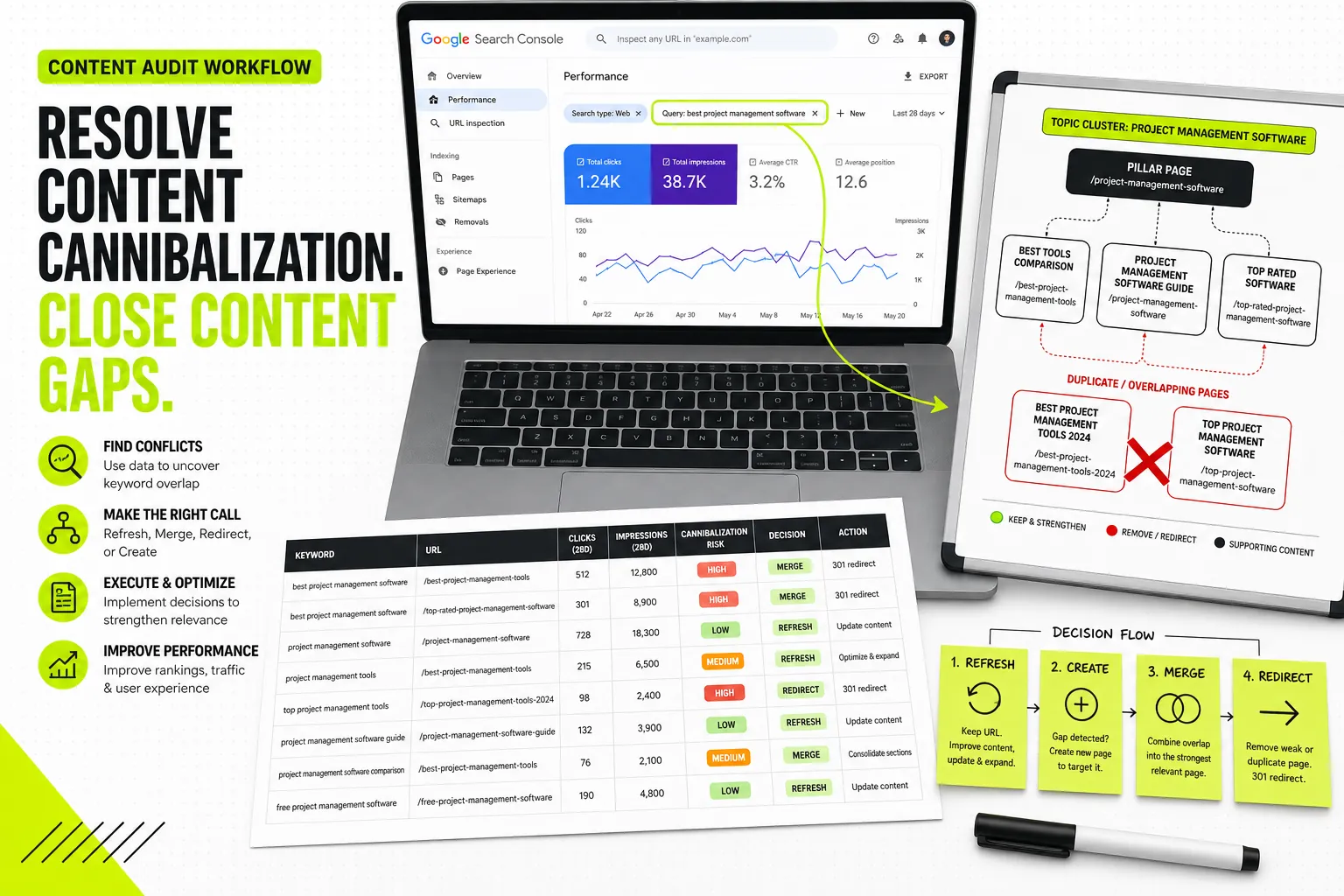
Step 3: Decide to refresh, consolidate, or create—using a decision matrix
For each priority page, the diagnostic data points to one of three moves:
| Signal pattern | Decision | Action |
|---|---|---|
| Ranks well, CTR decaying, content is commodity-grade | Refresh | Add information gain (original data, examples, tables), restructure into extractable answer blocks, strengthen attribution — make it the citable source rather than the summarizable one |
| Multiple thin pages splitting impressions for one query cluster | Consolidate | Merge into one authoritative page, 301 the rest; fragmented coverage loses passage-level retrieval to focused competitors |
| Fan-out sub-queries appearing in GSC with no dedicated page answering them | Create | Build a specific page per sub-question cluster — these are citations competitors haven’t claimed yet |
| Stable CTR, low exposure class | Leave alone | Spend the effort elsewhere |
The “create” row is where most teams underinvest: your GSC data already shows the long-tail sub-queries AI Mode fans out into — queries where you get impressions at position 12–30 with no page truly targeting them. Executing refresh and creation decisions at scale is where AI SEO tools for content and workflows earn their keep — provided the AI is working from your search data and site context rather than generating in a vacuum.
Re-run the diagnostic quarterly. AI Mode’s behavior is still shifting; your segmentation from six months ago is already partially stale.
Mythbusting: What You Do Not Need to Do for AI Mode
The vendor ecosystem has a financial incentive to make AI Mode feel like an emergency requiring new everything. Most of it isn’t true.
No special markup or secret AI Mode optimization exists
There is no llms.txt requirement, no special meta tag, no schema type that unlocks AI Mode citations, and no “GEO trick” that bypasses content quality. Google has been explicit that AI experiences draw on the same index and the same quality systems as regular search. Anyone selling a proprietary AI Mode optimization technique that isn’t reducible to “make crawlable, well-structured, well-evidenced content” is selling repackaged fundamentals at a markup — or selling nothing.
Why chasing every AI tracker metric wastes time
AI visibility trackers sample prompts and report whether you appear. Useful as a directional signal; dangerous as a KPI. The problems: answers vary run-to-run and user-to-user, prompt samples may not match how your audience actually asks, and vendor visibility scores aren’t comparable across tools or verifiable against anything. Teams that anchor on tracker scores end up optimizing for the tracker’s prompt set instead of their market.
The fix is the hierarchy this guide is built on: GSC patterns and branded query growth as your primary evidence, sampled citation checks on your priority topics as a secondary signal, vendor scores as a distant third.
Foundational SEO still does the heavy lifting
Everything AI Mode rewards — crawlability, intent-matched content, demonstrated expertise, evidence, internal link structure, topical depth — is what strong SEO programs were already doing. AI Mode changed the distribution of clicks and the unit of visibility, not the underlying physics of what earns trust from Google’s systems. If your fundamentals are weak, no AI-specific tactic compensates; if they’re strong, AI Mode citation is largely a byproduct. Our breakdown of the foundational SEO elements for AI search covers that full framework — crawlability, relevance, authority, usefulness, and measurement — and why GEO and AEO are outcomes of it rather than replacements for it.
Frequently Asked Questions
Will Google AI Mode reduce my organic traffic, and by how much?
It depends entirely on your query mix. Sites heavy in definitional and simple informational queries are seeing meaningful CTR decay on those segments — relative drops of 20–50% are commonly reported — while transactional, branded, and tool-dependent queries are largely stable. Run the query-class segmentation in this guide against your own GSC data; a site-specific answer takes an afternoon and beats any industry average.
How can I tell in Google Search Console whether a query is being answered by AI Mode?
You can’t directly — GSC blends AI experience data into overall performance with no AI Mode filter. The reliable inference is the pattern: stable average position, stable-or-rising impressions, declining CTR, concentrated in high-exposure query classes. When all three line up, AI-layer absorption is the most probable cause.
Does appearing in AI Mode pass any click-through value, or is it purely zero-click?
Citations do pass clicks — users click sources to verify, go deeper, or use tools — but at lower rates than traditional blue links. The compensating value is brand exposure: being named in answers drives branded search demand, and AI-referred visitors who do click tend to arrive pre-qualified and convert at higher rates.
Can a small site without brand authority get cited in AI Mode answers?
Yes, because retrieval works at the passage level via query fan-out. A small site that answers a specific sub-question better than anyone — with original data, clear structure, and evidenced claims — can be cited over larger generalist publishers. The viable path is narrow topical dominance, not broad coverage.
Do I need different content for AI Mode than for AI Overviews?
No. Both run on the same index, similar retrieval mechanics, and the same quality systems. Content that is crawlable, passage-extractable, well-evidenced, and genuinely informative serves both. AI Mode skews toward longer, more complex conversational queries, so deep coverage of sub-questions matters somewhat more there — but it’s one content strategy, not two.
How do I get my pages cited as a source in AI Mode responses?
Earn retrieval and trust: target the sub-queries that fan-out generates (your GSC long tail reveals them), lead each section with a direct, self-contained answer, include information competitors don’t have, attribute every claim, and maintain clean technical access and schema. Then sample your priority topics in AI Mode monthly to verify.
Should I block or allow Google-Extended and other AI crawlers?
Allow them, in almost all B2B cases. Note that Google-Extended only controls Gemini model training — blocking it does not remove you from AI Mode, which uses standard Googlebot. For GPTBot, PerplexityBot, and similar crawlers, blocking removes you from those engines’ answers; for brands that benefit from being recommended in AI research, that’s a pure visibility loss.
How often does AI Mode update which sources it cites?
Continuously. AI Mode retrieves from Google’s live index at query time, so citation sets shift as content is published, updated, and re-evaluated — and the same query can cite different sources across sessions. Practically: check citation presence on priority topics monthly, and expect content refreshes with genuine improvements to show up in citations within days to weeks of re-crawling, not months.