Most keyword grouping advice stops at the algorithm. You feed in a list, a tool spits out clusters, and you’re left to figure out what to actually publish. Semantic keyword grouping done well closes that gap—it organizes queries by what people mean, then routes each group to a real decision: a new page, an existing page, or a refresh. This is the part where Search Console data, intent, and your existing site structure all have to agree before a single brief gets written.
What follows is a repeatable, GSC-first workflow built for teams managing content strategy from real performance data—not modeled keyword volume from a third-party export.
What Is Semantic Keyword Grouping?
A plain-English definition for SEO teams
Semantic keyword grouping is the practice of organizing keywords by shared meaning and intent rather than by shared words. Instead of bucketing “best CRM software” with “best CRM software for nonprofits” just because they share four words, you group queries that point a searcher toward the same answer—even when the wording is completely different.
So “how to reduce customer churn,” “stop losing subscribers,” and “lower SaaS attrition rate” can belong in the same group. They share almost no exact-match overlap, but they represent one underlying information need. That’s the unit you build content around.
Why meaning matters more than exact-match phrases
Google stopped rewarding exact-match keyword density years ago. Modern ranking systems interpret queries with natural language understanding, so a single well-built page can satisfy dozens of phrasings of the same question. Grouping by surface text fights against how search actually works—you end up with thin pages targeting near-identical needs, and they cannibalize each other.
Grouping by meaning aligns your content map with the way Google already understands topics. One page, one need, many phrasings satisfied.
Where semantic keyword grouping fits in the content workflow
Grouping sits between raw query discovery and brief creation. You pull queries (ideally from Google Search Console), group them by meaning, validate those groups against real ranking behavior, and only then decide what to publish. Skip the grouping step and you get a content calendar full of overlapping posts. Do it well and every brief that follows has a clear primary keyword, a defined intent, and a planned place in your site architecture.
Semantic Keyword Grouping vs. Traditional Keyword Clustering
Grouping by shared words vs. grouping by shared meaning
Traditional clustering often relies on lexical matching—n-grams and root phrases. It groups keywords that share text. That’s fast and cheap, but it confuses similar wording with similar purpose. “Project management software” and “project management app” get clustered because they share words, which is fine. “Project management software” and “project management certification” might also get pulled together by a naive tool, even though one is a buyer and one is a student.
Semantic grouping uses meaning as the test. The question isn’t “do these strings overlap?” but “will the same content satisfy both searchers?”
Why search intent can split similar-looking keywords
Two queries can be lexically identical in spirit and still belong on different pages because the user intent diverges. “Email marketing” might be informational for one searcher and commercial for another, depending on the surrounding modifiers and the SERP Google returns. “Best email marketing tool” and “what is email marketing” share the head term but want entirely different pages—one is a comparison, one is a definition.
Intent is the splitter. Semantic similarity tells you keywords are related; intent tells you whether they can live together.
When SERP overlap should override semantic similarity
Here’s the rule that saves teams from over-trusting any model: when semantic similarity and SERP overlap disagree, SERP overlap usually wins. If two keywords feel related but Google ranks completely different pages for each, those are two pages. If two keywords feel different but Google ranks the same URLs for both, that’s one page.
Google’s results are the closest thing to ground truth about how the search engine has interpreted intent. A common working threshold is three or more shared page-one URLs to treat two queries as one target.
Why Semantic Keyword Grouping Matters for Modern SEO
Build topical authority instead of isolated blog posts
Topical authority comes from covering a subject completely and connecting that coverage coherently—not from publishing one-off posts that happen to rank. Semantic groups become the blueprint for topic clusters: a pillar page covering the broad subject, supporting pages covering each distinct subtopic, all linked together. When your groups map cleanly to a pillar-and-spoke structure, you signal depth to both readers and search engines.
Match how users explore a topic across the funnel
People rarely search once. They start broad (“what is lead scoring”), get more specific (“lead scoring models”), and eventually go commercial (“lead scoring software”). Semantic grouping lets you see those stages side by side and assign each to the right page type. You stop forcing a definition query and a software query onto the same URL, and you start building a content set that meets users wherever they enter the funnel.
Reduce cannibalization before content is assigned
Keyword cannibalization is cheaper to prevent than to fix. Once you’ve published two pages chasing the same intent, untangling them means consolidation, redirects, and lost momentum. Grouping is where you catch it early—if two prospective topics resolve to the same group and the same SERP, you’ve just prevented a duplicate page before it was ever assigned to a writer.
Turn query data into clearer briefs and internal links
A well-formed group is most of a content brief already: it names the primary keyword, lists the supporting variants, fixes the intent, and points to where the page should sit in your structure. It also tells you which existing pages should link in. Grouping isn’t busywork upstream of “real” work—it’s the work that makes every downstream brief faster and sharper.
The Dango Framework: Group Keywords by Meaning, Intent, and Site Context
This six-step workflow is built around first-party data and your actual site, so the groups you create reflect how your domain performs—not a generic keyword list that could belong to anyone.
Step 1: Start with real Google Search Console queries
Begin with the queries your site already shows up for. Google Search Console reports impressions, clicks, and average position for the terms Google has actually associated with your pages. That’s a meaningful advantage over modeled volume: a GSC query proves Google already considers your domain relevant, and high-impression, low-click queries point straight at your fastest wins.
This is the core reason a GSC-native approach beats a generic export. If you’re weighing methodologies, this GSC-native keyword clustering tool comparison breaks down how first-party query data improves grouping accuracy against SERP-based and pure-NLP approaches.
Step 2: Normalize keyword variants without losing intent
GSC exports are messy—plurals, word-order variations, typos, and near-duplicates everywhere. Normalize them: collapse “crm software” and “software crm” and “crm softwares” into one canonical variant. The discipline here is to clean noise without flattening intent. “CRM software” and “CRM software free” look similar but the “free” modifier may pull a different SERP. Normalize spelling and order; preserve modifiers that change meaning.
Step 3: Label every query by user intent and page type
Tag each query with its dominant intent—informational, commercial, transactional, or navigational—and the page type that serves it (guide, comparison, landing page, template, etc.). This is the step that prevents the most common grouping error: mixing a “what is” definition with a “best tool” comparison just because they share a head term. If two queries carry different intents, they probably want different pages even when they sit in the same broad topic.
Step 4: Validate clusters with SERP overlap
Now pressure-test each group against live results. For the queries you’ve grouped, check whether Google ranks overlapping URLs. If “lead scoring model” and “lead scoring framework” return three or more shared page-one results, confirm them as one target. If they don’t overlap, split them.
SERP-based tools specialize in this check, and they’re strong for net-new topics where you have no GSC history. This breakdown of SERP-based keyword clustering and grouping shows how that methodology compares with semantic and GSC-native grouping—useful context for deciding when to lean on SERP data versus your own performance data.
Step 5: Map each group to a new, existing, or refreshed URL
Every validated group needs a destination. Three options:
- New page — no existing URL serves this intent.
- Existing page — a live page already ranks for this group; route the group there to strengthen it.
- Refresh — a page exists but underperforms; expand or restructure it around the group.
Checking existing pages first is what keeps a site-aware workflow from quietly duplicating content you already own.
Step 6: Add internal links before publishing
Plan links at the group stage, not after the article goes live. Decide which existing pages will link into the new content and which new content links back out. For topic clusters specifically, plan the hub-to-spoke, spoke-to-hub, and spoke-to-spoke connections deliberately. These hub-and-spoke internal linking patterns explain how semantic groups should connect so authority flows through the cluster instead of stranding pages as orphans.
How to Classify Search Intent Inside a Semantic Keyword Group
Intent classification is what turns a pile of related keywords into a publishable structure. Within a single broad topic you’ll usually find several intents, and each maps to a different page.
Informational intent: definitions, guides, and workflows
These searchers want to understand something: “what is,” “how to,” “guide to,” “best practices for.” They feed your educational content—pillar pages, tutorials, and workflow walkthroughs. Informational groups tend to be the largest and form the backbone of topical authority.
Commercial intent: tools, software, and comparisons
Here the searcher is evaluating options before buying: “best,” “top,” “vs,” “alternatives,” “review.” These queries want comparison pages, listicles, and tool roundups—not definitions. Mixing them into an informational guide weakens both; keep commercial groups on dedicated evaluation pages.
Transactional intent: templates, trials, and implementation help
Transactional queries signal readiness to act: “template,” “free trial,” “pricing,” “download,” “hire.” These map to product pages, signup flows, and downloadable assets. For a content team, transactional groups often justify a lead magnet or a bottom-of-funnel page rather than another blog post.
Navigational intent: branded and product-led queries
Navigational searches name a brand or product: “[your product] login,” “[your product] integration,” “[competitor] pricing.” These are owned by product and landing pages, not blog content. Identifying them keeps you from writing editorial content for queries that should resolve on a product surface.
How to Decide Whether Keywords Belong on One Page or Separate Pages
This is the decision that makes or breaks a content plan. Four checks resolve most cases.
Use SERP similarity to test page-level overlap
Run the SERP overlap check from Step 4 at the pair level. Shared ranking URLs are the strongest evidence that one page can win both queries. Three or more shared page-one results is a practical merge signal; near-zero overlap is a split signal.
Check whether the same content format ranks for both terms
Look at what ranks, not just which URLs. If one query returns listicles and the other returns step-by-step tutorials, Google is telling you those are different page types even if the topics are adjacent. Format divergence is a quiet but reliable split signal.
Look for intent conflicts inside the same keyword group
If a group contains both “what is X” and “best X tools,” you have an informational/commercial conflict. Split it. A single page rarely satisfies a learner and a buyer equally, and trying to serve both usually means serving neither.
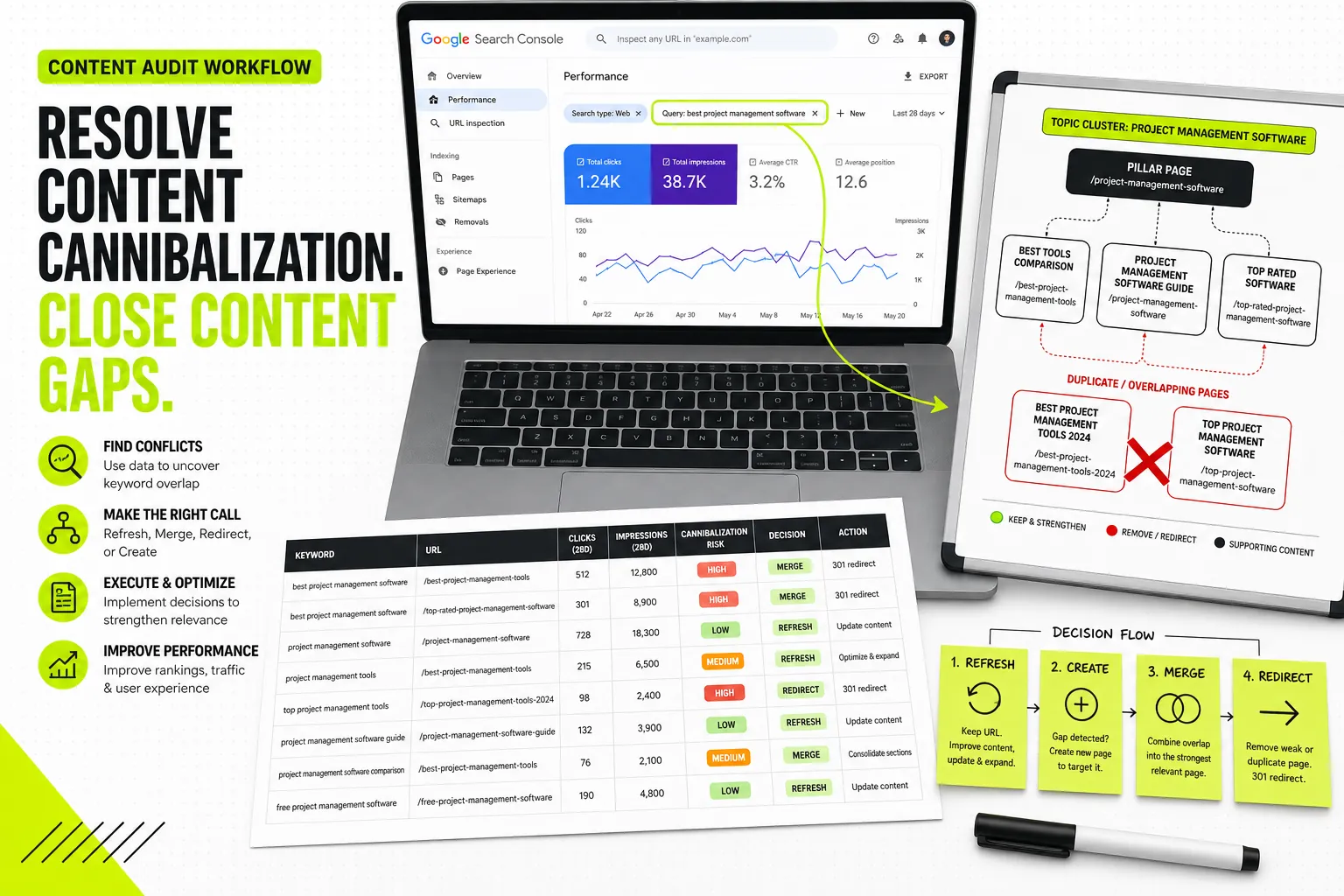
Create a split, merge, or refresh decision for every cluster
End every cluster with an explicit verdict: split into multiple pages, merge onto one, or refresh an existing URL. For concrete walkthroughs of how groups become these decisions in practice, these keyword clustering workflow examples show the split/merge/refresh logic applied to real query data.
A Practical Semantic Keyword Grouping Template
A grouping worksheet keeps the whole process auditable and hands writers everything they need.
Columns to include in your grouping worksheet
At minimum, your worksheet should carry:
- Primary keyword — the canonical term that names the group
- Variants — normalized phrasings the page should also satisfy
- GSC metrics — impressions, clicks, average position for each query
- Intent — informational, commercial, transactional, or navigational
- Page type — guide, comparison, landing page, template, etc.
- URL status — new, existing, or refresh, plus the target URL
- Internal links — inbound and outbound links to plan
- Confidence score — your certainty the group is correct
Example cluster structure: primary keyword, variants, intent, page type, URL status, and internal links
A finished cluster might read:
- Primary keyword: lead scoring models
- Variants: types of lead scoring, lead scoring framework, predictive lead scoring
- GSC signal: 2,400 impressions, position 14, low CTR
- Intent: informational
- Page type: guide / supporting page under a “lead scoring” pillar
- URL status: refresh existing
/blog/lead-scoringpost - Internal links: in from the lead scoring pillar; out to “lead scoring software” comparison
That single row is roughly 70% of a content brief.
How to score confidence before creating a content brief
Score each group before it advances. High confidence means semantic grouping, intent, and SERP overlap all agree—proceed to brief. Medium confidence means one signal is borderline—flag for manual SERP review. Low confidence means signals conflict—hold and investigate. Scoring stops weak clusters from becoming weak articles, and it tells your team exactly where human judgment is needed.
Common Mistakes That Break Semantic Keyword Groups
Grouping keywords only because they share the same modifier
“Best CRM,” “best CRM for nonprofits,” and “best CRM certification” all share “best,” but they’re a comparison, a niche comparison, and an educational query. Shared modifiers are not shared intent. Test every group against meaning and SERP, not surface text.
Ignoring existing pages that already satisfy the intent
If you skip the check against live URLs, you’ll commission new content for intents your site already covers. Always ask whether an existing page should absorb the group before you create a new one. This single habit prevents most self-inflicted cannibalization.
Creating multiple pages for the same SERP
When two groups resolve to the same set of ranking URLs, building two pages just splits your own authority across competing assets. If the SERP is one SERP, the page should be one page.
Skipping internal links until after publishing
Publishing without planned links is the most common and most damaging execution mistake in content operations. Pages launch as orphans, the cluster never coheres, and authority never flows. Plan links in the worksheet, before the draft exists.
Trusting AI clusters without human review
AI grouping is fast and genuinely useful, but it can confidently merge intents or miss SERP reality. Treat machine output as a strong first draft, not a verdict. The validation steps—intent labeling and SERP overlap—are where a human keeps the AI honest.
How AI Can Help With Semantic Keyword Grouping
Using NLP and embeddings to detect semantic similarity
This is where AI shines. NLP models convert keywords into embeddings—numerical representations of meaning—and measure how close they sit in semantic space. That lets a model recognize that “reduce churn” and “improve retention” belong together despite zero word overlap, at a scale no human could match manually.
Where AI clustering needs GSC and SERP validation
Embeddings measure meaning, but meaning isn’t the same as ranking behavior. Two semantically close keywords can return entirely different SERPs, and a pure-NLP cluster won’t know that. Ground the embeddings in real data: validate against GSC performance and SERP overlap so your groups reflect how Google actually treats the queries, not just how a language model scores their similarity.
How site-aware AI reduces duplicate content risk
The biggest advantage of grounding AI in your own site is duplicate prevention. When the model knows which pages you’ve already published, it can flag that a proposed group is already served by an existing URL—turning a “new page” decision into a “refresh” decision. That site awareness is exactly what generic clustering tools lack. For a broader look at how grounded tools support clustering, cannibalization checks, and link planning, see this rundown of AI SEO tools for keyword clustering .
What to review manually before approving a cluster
Before any cluster ships to a brief, a human should confirm: the intent label is correct, the SERP overlap supports the grouping, the chosen URL status matches your existing inventory, and the planned internal links are genuinely relevant. AI gets you 80% of the way at speed; that last 20% of judgment is what protects rankings.
From Semantic Keyword Groups to Publishable Content Briefs
A validated group is a brief waiting to be written. Here’s how to make the handoff clean.
Choose the primary keyword and supporting terms
Pick the one term that best represents the group’s intent and has the strongest GSC signal—usually high impressions with room to climb. The remaining variants become supporting terms the page should naturally cover. The primary keyword anchors the title, H1, and URL; the supporting terms shape the subheadings.
Define the page angle based on ranking intent
Let the SERP dictate format. If the pages ranking for your group are step-by-step guides, write a guide. If they’re comparison tables, build a comparison. The angle isn’t a creative choice made in a vacuum—it’s a response to what Google has already decided satisfies this intent.
Map internal links from related pages
Carry the link plan from your worksheet straight into the brief. Specify which existing pages link in, what anchor text to use, and which outbound links the new page should include. For cluster content, confirm the hub-and-spoke connections so the new page slots into your existing topical structure rather than floating alone.
Turn the group into an outline, FAQ set, and optimization checklist
Finally, expand the group into a working outline: the primary keyword sets the H1, supporting terms become H2s, and unanswered variant questions become an FAQ section. Add an optimization checklist—title, meta, internal links, intent match—so the writer ships a complete, SEO-ready draft instead of raw prose someone else has to fix.
Frequently Asked Questions
How many keywords should be in one semantic keyword group?
There’s no fixed number—group size should follow intent, not a target count. Some groups have three queries; others have thirty variant phrasings of the same need. The real test is whether one page can satisfy every query in the group. If you can’t picture a single page serving them all, the group is too broad and needs splitting.
Can semantic keyword grouping be done manually?
Yes, and for small sets it’s often the most accurate approach. Manual grouping uses human judgment about meaning and intent, which catches nuances tools miss. The trade-off is scale: once you’re working with hundreds or thousands of queries, manual grouping becomes impractical, and that’s where NLP embeddings and automated clustering earn their place—ideally with manual validation on the borderline cases.
What is the difference between semantic similarity and SERP similarity?
Semantic similarity measures how close two keywords are in meaning, calculated from language models and embeddings. SERP similarity measures how many ranking URLs two keywords share in Google’s actual results. They often agree, but when they don’t, SERP similarity is the stronger signal because it reflects how Google itself has interpreted the intent—not just how similar the words sound.
Should one keyword group always become one article?
No. Most well-formed groups map to one page, but not always. A group may reveal an intent conflict that warrants a split into two pages, or it might map to an existing page that just needs a refresh rather than a new article. The group is an input to a content decision, not an automatic one-to-one trade for a new post.
How does semantic keyword grouping help prevent keyword cannibalization?
It catches overlap before content exists. When you group by meaning and validate with SERP overlap, two prospective topics that resolve to the same intent and the same ranking URLs collapse into one group—and one page. That stops you from publishing competing pages in the first place, which is far cheaper than consolidating duplicates after they’ve split your authority.
Can Google Search Console data replace third-party keyword research tools?
For established sites, GSC data is the strongest foundation because it shows queries Google already associates with your domain, complete with real impressions and positions. It does have a blind spot: it only reports terms you already rank for, so for net-new topic areas with no history, third-party tools and SERP-based clustering still add value. The best workflow combines them—GSC for what you own, external data for what you want to enter.
How often should SEO teams regroup keywords?
Regroup on a regular cadence and after major events. A quarterly review catches new queries surfacing in GSC and shifts in SERP behavior. Beyond that, regroup after a Google update, a significant content push, or when a page’s performance changes sharply. Keyword groups aren’t static—they reflect a moving SERP and a growing site.
What tools are useful for semantic keyword grouping?
You’ll typically combine a few capabilities: a source of query data (Google Search Console for first-party signals), NLP or embedding-based clustering for semantic similarity at scale, SERP analysis for overlap validation, and a worksheet or platform to manage the split/merge/refresh decisions and internal link plans. Site-aware platforms that connect directly to GSC reduce the most steps because they ground grouping in your actual rankings and existing pages, rather than asking you to reconcile a generic export by hand.